

About this archive
Last updated 7 October 2026 · 12 sources
visitjane.com is an independent reference site about Jane, the young tyrannosaur catalogued as BMRP 2002.4.1 and displayed at the Burpee Museum of Natural History in Rockford, Illinois.4,5 It is not affiliated with the Burpee Museum and does not speak for it.
Who runs this site
visitjane.com is run as an independent project under the name VisitJane Archive. It has no connection with the Burpee Museum of Natural History, with the scientists whose work it reports, or with the people who made the original website. Nobody involved is a palaeontologist, and no one here has handled the specimen. The site names no individual author, because the pages are meant to stand on the sources they cite and not on anyone's authority. Questions and corrections reach the archive at [email protected].
What this site was, and why it is kept
The address visitjane.com earlier carried a site about Jane and the museum's exhibit "Jane: Diary of a Dinosaur", which opened on 29 June 2005.2 Its pages presented the museum's exhibit to visitors and told the story of the discovery and the excavation.
What is known about who made it comes from the old site itself. The footer of its home page carried copyright lines for the Rockford Area Convention & Visitors Bureau and the Burpee Museum of Natural History, and credited design and programming to GrahamSpencer and sound to Engine Studio.1 No independent source for those website credits was found. A firm of nearly the same name, Engine Studios of Rockford, is documented separately as a partner in the exhibit's media, which makes the sound credit plausible but does not confirm it.2
Two things could not be established: the date the original site went online, and whether it was ever covered in the press. The Internet Archive's index was unavailable when the research for this page was done (October 2026), and searches found no report about the website itself. This page will be updated if either turns up.
The site is kept because the original pages recorded how the fossil was presented to the public at the time, and because an address that other sites once pointed to is more useful kept than abandoned. Rather than let the address go dark or carry unrelated content, the pages have been rewritten as a reference on one fossil: what Jane is, how it was found and prepared, what has been published about it, and where the skeleton can be seen. The museum, the scientists and the earlier makers of the site named on these pages have no part in it and are not responsible for anything it says.
How the pages are made
- Numbers, dates, names and quotations are tied to a published source. Each carries a numbered reference, and the full list of sources is at the foot of each page. Scientific papers, the museum's own pages and institutional press releases come first; news reports are used for context and for what people said on the record.
- Not every paper could be read in full. Some sit behind paywalls. For those the page relied on the abstract, the supplementary material or an openly deposited copy of the text, and the source entries say so in the most important cases.
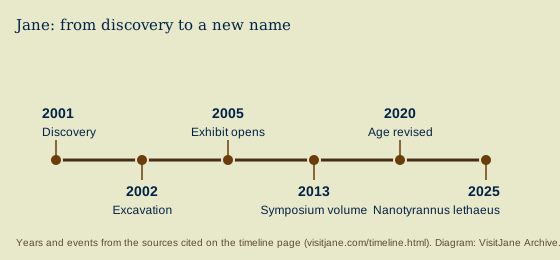
- Conflicting figures are shown side by side. Jane's age at death is a good example: the first published figure was 11 years, a 2020 study of the leg bones gave at least 13, and the 2025 Nature paper re-read the published thigh-bone section as eight years of growth.3,4,6 The pages give the main published figures with the name of whoever produced each one, and do not average them or pick one silently.
- Disputed questions are presented by position. The largest is what kind of animal Jane is. A 2025 paper in Nature made Jane the type specimen of a new species, Nanotyrannus lethaeus; Thomas Carr, described by Live Science as having studied Jane extensively, says Jane is a juvenile Tyrannosaurus rex.6,7 The pages say who holds which view and do not declare a winner. See Is Jane a Nanotyrannus?
- Unknowns are stated. Jane's sex is not known.8 The rewritten pages call Jane "it", except where they quote or describe people who say "she". Where the research found no answer, the page says that no answer was found.
- Dates are as precise as the sources. If a source gives only a year, the page gives only the year.
- Quotations are exact. Words inside quotation marks are reproduced as published.
- Each article page carries a last-updated date at the top, next to the count of its sources.
What changed from the original site, and why
The original pages were written to accompany an exhibit, and research on the skeleton has moved on since. The main changes:
| Original site | Now |
|---|---|
| Jane is a juvenile T. rex | Disputed. Jane was named the type specimen of Nanotyrannus lethaeus in 2025, and some researchers still regard it as a juvenile T. rex. On both readings Jane is a young animal.6,7 |
| 11 years old at death | At least 13, from a 2020 count of growth marks in the thigh bone. The figure of 11 was the first estimate, from other bones.3,4 |
| 145 of 297 bones uncovered | 145 bones, about 52 percent of the skeleton, according to the excavators' published account. No source was found for a total of 297.3 |
| A speed of "20-30 miles per hour" | Removed. No published running speed for Jane was found; the museum's current page describes a fast runner without giving a number.9 |
| "Tiny" arms | In one three-dimensional model Jane's arm is 2.8 percent of body mass, against 0.1 to 0.4 percent in adult T. rex.10 Whether that is a difference of age or of species depends on the identity question. |
| About 35 T. rex skeletons in the world | A 2025 count by Thomas Carr lists 61 T. rex fossils in public collections and 71 in private hands. It counts fossils of varying completeness, and was made when small specimens such as Jane were counted as T. rex, so it cannot be set directly against the old figure of 35 skeletons.11 |
| The Cretaceous ended 65 million years ago | The end of the Cretaceous in the Hell Creek region has since been dated to about 66.05 million years ago.12 |
Other statements on the old pages could not be confirmed in any source that could be opened. Those have been left out, and the rewritten page says so where a reader might look for them. The museum's first-person voice has gone, its copyright line has been reworded, and a newsletter sign-up form that no longer worked has been removed.
The page addresses have changed as well: the original long addresses redirect to the short ones used now.
Images
The original design, logo and header graphics of the site are kept. The original site's content photographs are being replaced by freely licensed images: public domain, or Creative Commons licences that allow reuse with credit. Each of the new images carries a credit line naming the photographer and the licence, with links to the original file and the licence text, and a note when the image has been resized.
Captions say what the picture shows: which museum, and whether the object is original fossil, a cast or a reconstruction. Figures from scientific papers are not reproduced unless the paper's licence allows it.
What this archive cannot do
- It has no access to the specimen. Nothing here comes from examining Jane's bones. Every measurement, count and age is somebody else's published result, and the pages name whose.
- It is not written by specialists. The people maintaining the site are not palaeontologists and have not visited the Burpee Museum. The pages do not judge which scientific position is right; they report who holds which view.
- It depends on what could be read. Several papers are behind paywalls and were used through their abstracts and supplementary files. Where a claim rests on such partial reading, the source entry says so.
- It can lag behind the research. The identity question is live, and new work may change figures given here. The last-updated date at the top of each page shows when it was last checked.
- It cannot answer visitor questions. Opening hours, tickets and events are the museum's business and are not recorded here.
Reporting a correction
Corrections are welcome, especially from people who worked on Jane or who know of a published source this site has missed. Write to [email protected]. This address reaches the archive only, not the museum.
A useful report names the page, quotes the sentence, and points to a published source for the correction. Changes are made on the page and its last-updated date is moved forward.
Related pages: Jane timeline · Vital Statistics · Is Jane a Nanotyrannus? · Where Jane lives · Contact
Sources
- visitjane.com, original site: footer of the home page and page source of the "Where's Jane" page, as preserved in this archive's backup copy. Used as a record of what the old site said about itself, not as an independent source.
- Advanced Computing Center for the Arts and Design, The Ohio State University. "Jane: Diary of a Dinosaur." Project page. accad.osu.edu. Accessed 5 October 2026.
- Henderson, M. D. & Harrison, W. H. (2008). Taphonomy and environment of deposition of a juvenile tyrannosaurid skeleton from the Hell Creek Formation (latest Maastrichtian) of southeastern Montana. In Larson & Carpenter (eds), Tyrannosaurus rex, the Tyrant King, Indiana University Press, pp. 82–90. Read in a text extraction deposited at zenodo.org/records/4572551.
- Woodward, H. N., Tremaine, K., Williams, S. A., Zanno, L. E., Horner, J. R. & Myhrvold, N. P. (2020). Growing up Tyrannosaurus rex: Osteohistology refutes the pygmy "Nanotyrannus" and supports ontogenetic niche partitioning in juvenile Tyrannosaurus. Science Advances 6(1): eaax6250. doi:10.1126/sciadv.aax6250
- Research Casting International. "Jane the Tyrannosaurus Rex." Case study. rescast.com. Accessed 5 October 2026.
- Zanno, L. E. & Napoli, J. G. (2025). Nanotyrannus and Tyrannosaurus coexisted at the close of the Cretaceous. Nature 648: 357–367, published online 30 October 2025, with Supplementary Information. doi:10.1038/s41586-025-09801-6. The main text is behind a paywall; this page relies on the abstract and the Supplementary Information.
- Simms, C. (2025). "Nanotyrannus isn't a 'mini T. Rex' after all — it's a new species, 'dueling dinosaurs' fossil reveals." Live Science, 30 October 2025. livescience.com
- Burpee Museum of Natural History (2015). "Jane: Do the tails tell the tale?" No Stone Unturned (museum blog), 15 April 2015. blogburpee.wordpress.com
- Burpee Museum of Natural History. "Jane" (web page headed "Jane: NOT a juvenile Tyrannosaur??"). burpee.org/jane. Accessed 5 October 2026.
- Hutchinson, J. R., Bates, K. T., Molnar, J., Allen, V. & Makovicky, P. J. (2011). A computational analysis of limb and body dimensions in Tyrannosaurus rex with implications for locomotion, ontogeny, and growth. PLoS ONE 6(10): e26037. doi:10.1371/journal.pone.0026037
- Carr, T. D. (2025). Tyrannosaurus rex: An endangered species. Palaeontologia Electronica 28(1): a16. doi:10.26879/1337
- Sprain, C. J., Renne, P. R., Clemens, W. A. & Wilson, G. P. (2018). Calibration of chron C29r: New high-precision geochronologic and paleomagnetic constraints from the Hell Creek region, Montana. Geological Society of America Bulletin 130. doi:10.1130/b31890.1. Abstract only.