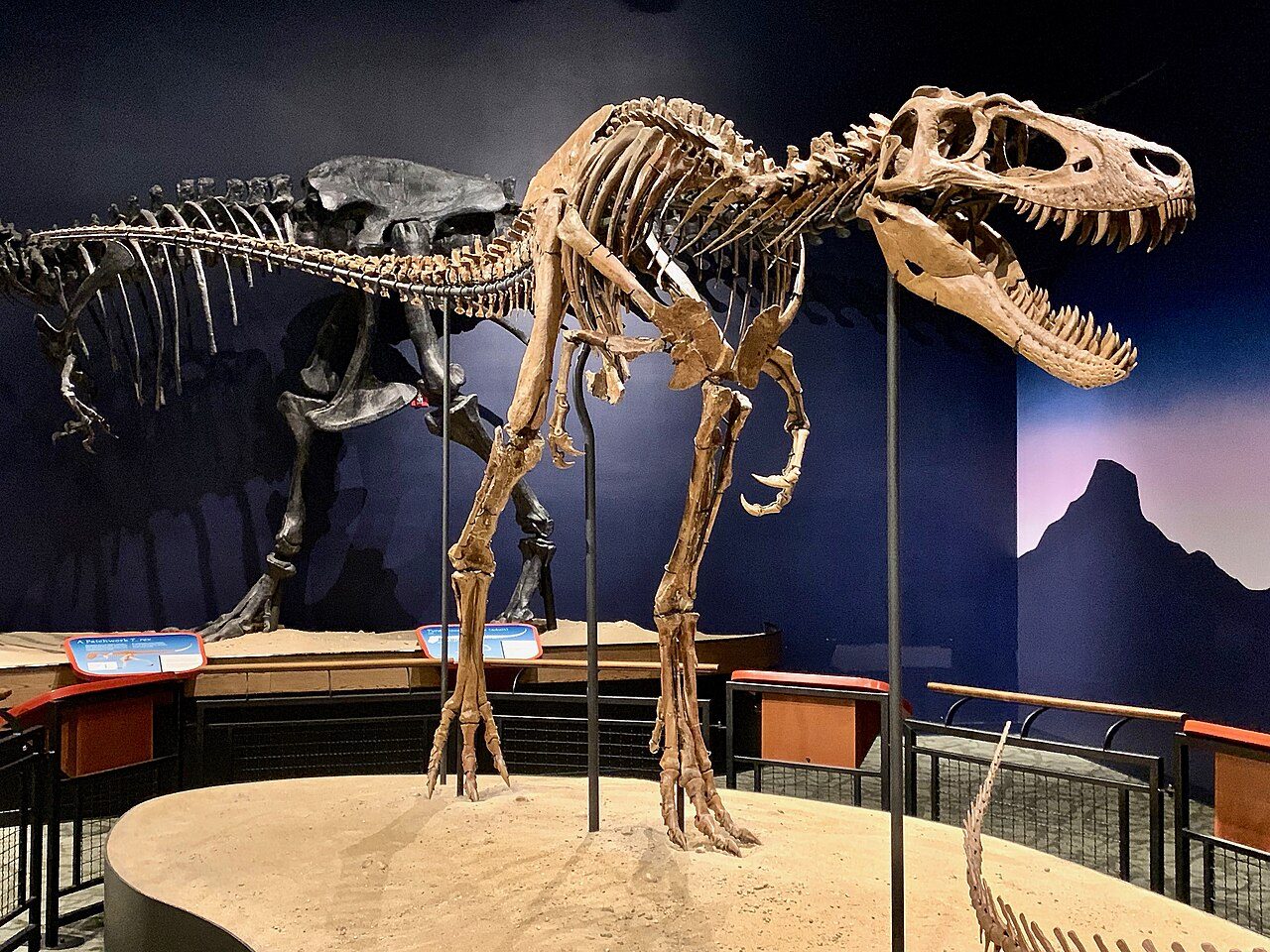
Jane is a young tyrannosaur about 6.4 to 7 metres (21 to 23 feet) long that was at least 13 years old when it died, in what is now southeastern Montana, near the end of the Cretaceous. Its catalogue number is BMRP 2002.4.1 and its skeleton is mounted at the Burpee Museum of Natural History in Rockford, Illinois.
The original version of this page gave a dozen one-line answers. Research on the skeleton since then has replaced several of them, and the largest change is to the first line: what kind of animal Jane is. The numbers below come from published studies of the specimen, each named next to its figure. Where studies disagree, the main published figures are given side by side.
Specimen
BMRP 2002.4.1, Burpee Museum of Natural History, Rockford, Illinois
Found
2001, by Carol Tuck and Bill Harrison on a Burpee Museum expedition; excavated in 20021,2,19
Where
Hell Creek Formation, Carter County, Montana, on public land managed by the Bureau of Land Management1,18
Identity
Disputed. Named as the type specimen of Nanotyrannus lethaeus in 2025; long classified as a juvenile Tyrannosaurus rex3
Growth stage
Juvenile, still growing at death (the bone-growth studies cited here agree)2,3,4
Age at death
At least 13 years (2020 count); 11 in the first estimate1,2
Length
About 7 m (23 ft) as estimated by the excavators; 6.45 m (21 ft) on a laser scan of a cast1,6
Hip height
Roughly 2 m (7 ft) according to the museum; 1.7 m (5 ft 7 in) calculated from leg length5,11
Body mass
575 to 1,269 kg (about 1,270 to 2,800 lb), depending on the method6,7,8
Jane's mounted skeleton at the Burpee Museum of Natural History, Rockford. Photo (resized): Zissoudisctrucker, CC BY-SA 4.0, via Wikimedia Commons.
What kind of dinosaur is Jane?
For most of the time since the discovery, published studies treated Jane as a juvenile Tyrannosaurus rex. In October 2025 Lindsay Zanno and James Napoli, describing a different fossil in the journal Nature, concluded that the small tyrannosaur Nanotyrannus is a separate animal from T. rex, and they made Jane the type specimen of a new species, Nanotyrannus lethaeus.3
Not every specialist accepts that for Jane. Thomas Carr of Carthage College, who has studied the skeleton at length, told Live Science on the day the paper appeared: "I have a different way of looking at the evidence and that is that Jane is a juvenile T. rex."17 A 2026 study of bone growth found that Jane does not grow like the other T. rex specimens in its sample, but its authors wrote that this result "cannot explain why they differ or how they should be classified."4
Why this matters for the rest of the page: on either reading Jane is a young animal that had not finished growing. What changes is the comparison. If Jane is a young T. rex, the differences from big T. rex skeletons are differences of age. If Jane is Nanotyrannus, they are differences between two kinds of tyrannosaur.
How old was Jane?
The figure of 11 years on the original version of this page came from Gregory Erickson, who examined thin sections of a rib, a fibula and a foot bone and reported the result to the excavation team in 2003.1
In 2020 a team led by Holly Woodward cut sections from the two main weight-bearing leg bones. They counted 13 yearly growth marks in the thigh bone and 10 in the shin bone, and concluded that Jane was at least 13 years old.2 The fibula had given a lower number because it grows more slowly than the bones that carry the body's weight.2 Thirteen is a minimum: growth marks from the earliest years are destroyed as the bone remodels itself, so an exact age cannot be read.2 Several papers published between 2009 and 2019 give 12, or 11 to 12, all resting on Erickson's work.6,12,15
The same bones show that Jane was not an adult. Neither carries the tightly packed outer layer that forms when an animal stops growing.2 The Burpee Museum now gives the age as "around 11–13 years old".5
Zanno and Napoli read the same thigh-bone section differently in 2025. They see the 13 marks as eight years of preserved growth, which is a statement about how much of the record survives and not a new age at death.3
How big was Jane?
The team that dug Jane up describes the animal as approximately 7 metres long.1 A 2011 study that laser-scanned a cast of the mounted skeleton measured 6.45 metres, with a leg 2.13 metres long.6 The museum's own figure is about 21 feet (6.4 metres) long and roughly 7 feet (2 metres) tall at the hips.5 A 2020 study of dinosaur locomotion calculated a hip height of 1.7 metres (5 ft 7 in) from the length of the leg in a walking posture.11
The skull is 71 to 74 centimetres long, depending on who measured it.2,8,9 All three are estimates: the skull was found in pieces, and the museum had the missing parts restored.20
For scale, the 2011 scanning study put four large adult T. rex skeletons at 11 to 12 metres long, and found Jane's measurements to be about 50 to 65 percent of theirs.6
How much did Jane weigh?
Each figure depends on the method used to reach it.
Estimate
Method
Study
639 to 1,269 kg, average 954 kg (1,410 to 2,800 lb)
3D model of a scanned cast, wrapped in a lean and a heavy version of the body
The original page said "nearly 1,500 lbs", which sits at the light end of this range. The same 2011 study modelled adult T. rex skeletons at 5,777 to 18,489 kg, so even the heaviest estimate for Jane is a fraction of an adult's.6
Teeth and bite
Jane's teeth are flattened from side to side, like blades.12 Thomas Carr measured 34 of them and found they are on average 54 percent as wide as they are long, against 71 to 85 percent in adult T. rex.9
Jane has 16 teeth in each upper jaw bone. Zanno and Napoli count 11 or 12 in every specimen they accept as T. rex.3 In Carr's growth series, which treats Jane as a young T. rex, animals at Jane's stage have 16 positions in the upper jaw and 17 in the lower, and the count falls as the animal grows.9 None of the studies read for this page states the count for Jane's own lower jaw. Tooth count is one of the centres of the identity argument: Longrich and Saitta answer Carr that within T. rex the count does not change with jaw size, so a higher count marks a different animal.8
Two kinds of bite estimate exist. One is a computer model of the jaw muscles of an animal Jane's size, which later papers cite as about 2,400 to 3,850 newtons at the back teeth.14 The other is an experiment based on the wounds on Jane's own face (see below). In 2021 Joseph Peterson and colleagues cast one of Jane's teeth in metal, pressed it into cattle bone, and worked out that the bite which wounded Jane landed with 5,269 to 5,641 newtons of force.14 That is the force of the animal that bit Jane, which the wounds show was about the same size. The authors concluded that a tyrannosaur at this stage could already puncture bone.14
Legs and speed
Jane has long legs for its size. W. S. Persons and Philip Currie list the thigh bone at 720 mm, the shin bone at 836 mm and the long middle foot bone at 563 mm, so the leg below the knee is nearly twice the length of the thigh.10 The thigh bone is incomplete, and other studies put it at 688 mm or, measured on a cast, 788 mm.2,6 On their scale of running adaptation Jane scores higher than any adult T. rex, and higher than young Albertosaurus and Gorgosaurus of similar size. They grouped Jane with Nanotyrannus and read the result as support for it.10
Two other studies used Jane as their young tyrannosaur. One found that juvenile tyrannosaurs weighing 300 to 700 kg were two to three times more agile at turning than adult allosaur-type predators of similar weight.7 The other noted that the long legs of tyrannosaurs under about 10 to 15 years old suit a high top speed.11
None of the studies consulted for this page gives a running speed for Jane in miles or kilometres per hour. The original page said "20-30 miles per hour"; no published source for that figure could be found, and it is not repeated here.
Arms
The original page called Jane's arms tiny, "typical for a member of the tyrannosaurid family". Measured against the body they are not. In the 2011 study, which modelled a scanned cast, Jane's arm made up 2.8 percent of body mass, compared with 0.1 to 0.4 percent in the four adult T. rex skeletons.6 Its authors read that as a change with age. Zanno and Napoli list larger arm bones among the features of Nanotyrannus as a genus, but left the arm out of their definition of Jane's species because Jane's own upper arm bone is heavily crushed.3 No study consulted here gives a measured length for Jane's upper arm bone, so the "about 11 inches" on the old page could not be checked.
Injuries
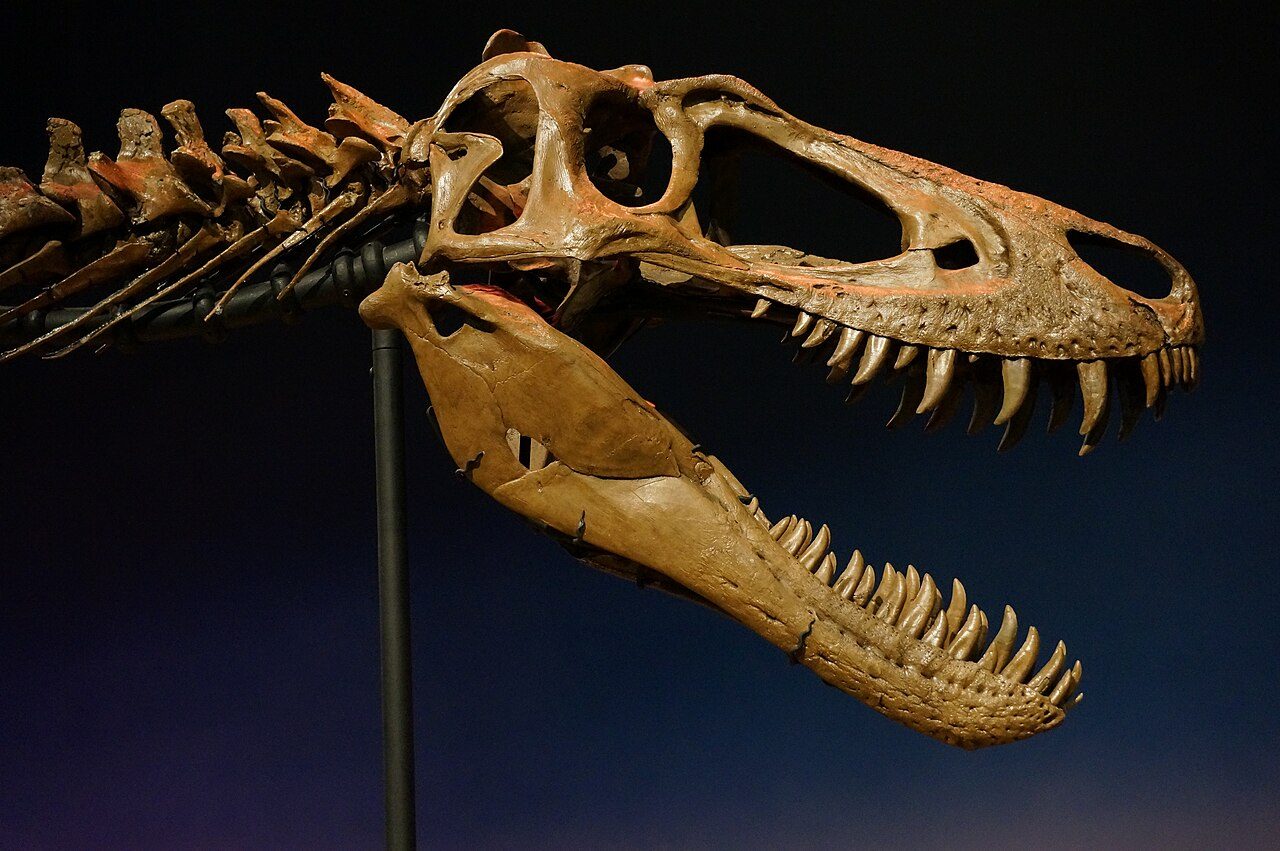
The restored skull of Jane on display at the Burpee Museum, seen from the right. The museum holds 23 original skull bones; about 40 percent of the skull was sculpted by the artist Tyler Keillor.20,21 Photo (resized): EarlRShumaker, CC BY 2.0, via Wikimedia Commons.
Jane's face was bitten by another tyrannosaur, and Jane survived it. A 2009 study led by Joseph Peterson describes four long wounds on the left upper jaw and the nasal bones, each between 10 and 19 mm long, that pass through the bone and had partly healed.12 Their size and spacing match Jane's own teeth, and the authors conclude that the attacker was a young tyrannosaur of about the same size.12 The injury appears to have left the snout slightly bent to the left as the skull grew.12 The authors suggest, and call it speculation, that the bite came from a fight over territory or rank of the kind seen in living crocodiles.12
A toe bone in the left foot carries a second problem: an infection that was still active when Jane died.12 It was later reported as a Brodie abscess, a walled-off pocket of infection inside the bone.13 The published burial study does not give a cause of death.1
Diet
Meat, as the original page said. The evidence is more specific now. A tail bone of the duck-billed dinosaur Edmontosaurus in the Burpee collection carries bite marks whose size and spacing match the teeth of a tyrannosaur at Jane's stage, which shows that animals like Jane fed on large plant-eaters at least some of the time.15 At an average estimate of 954 kg, Jane falls among mid-sized predators, a different place in the food chain from an adult T. rex weighing several tonnes.2
How complete is the skeleton?
The excavators recovered 145 bones, about 52 percent of the skeleton, from an area of four square metres.1 The museum describes the skeleton as 50 to 60 percent complete.5 Jane lay on its right side. The bones show no weathering, and the excavators concluded that a mudflow buried the body quickly.1
When did Jane live?
Between about 66 and 67 million years ago, the bracket Zanno and Napoli use for the skeleton.3 The excavators estimate Jane's level at 28 to 35 metres below the top of the Hell Creek Formation, by matching pollen and plant fossils from the quarry with a measured rock section in North Dakota. They call the placement complicated, and other papers say only "upper half" or "middle member".1,9,12 The top of the formation is the boundary that marks the extinction of the non-bird dinosaurs, dated to 66.05 million years ago.16
Male or female?
Unknown, as it was when this page was first written. The original page explained that Jane is called "she" because of the nickname, and that still holds. The 2009 study of the bite wounds placed Jane on a growth curve for T. rex and judged that the animal was probably not yet sexually mature. Carr has argued the opposite, that tyrannosaurs with skulls the size of Jane's had already reached sexual maturity.9,12
What the original page said, and what is known now
Original page
Now
Jane is a juvenile Tyrannosaurus rex
Disputed: type specimen of Nanotyrannus lethaeus since 2025, still a juvenile T. rex to some researchers
Lived 66 million years ago
Between about 66 and 67 million years ago
11 years old
At least 13
About 7.5 feet tall at the hip
Roughly 7 feet (museum); 5 ft 7 in calculated
About 21 feet long
21 to 23 feet (6.4 to 7 m)
Nearly 1,500 lbs
1,270 to 2,800 lb (575 to 1,269 kg), depending on method
Could run 20 to 30 miles per hour
No published speed; built for running and quick turns
Lower jaw has 17 teeth
Matches Carr's count for Jane's growth stage; Jane's own count is not stated in the studies read
Arms are tiny
Small, but far larger for the body than an adult T. rex's
Henderson, M. D. & Harrison, W. H. (2008). Taphonomy and environment of deposition of a juvenile tyrannosaurid skeleton from the Hell Creek Formation (latest Maastrichtian) of southeastern Montana. In Larson & Carpenter (eds), Tyrannosaurus rex, the Tyrant King, Indiana University Press, pp. 82–90.
Woodward, H. N., Tremaine, K., Williams, S. A., Zanno, L. E., Horner, J. R. & Myhrvold, N. P. (2020). Growing up Tyrannosaurus rex: Osteohistology refutes the pygmy "Nanotyrannus" and supports ontogenetic niche partitioning in juvenile Tyrannosaurus. Science Advances 6(1): eaax6250. doi:10.1126/sciadv.aax6250
Zanno, L. E. & Napoli, J. G. (2025). Nanotyrannus and Tyrannosaurus coexisted at the close of the Cretaceous. Nature 648: 357–367, with Supplementary Information. doi:10.1038/s41586-025-09801-6
Woodward, H. N., Myhrvold, N. P. & Horner, J. R. (2026). Prolonged growth and extended subadult development in the Tyrannosaurus rex species complex revealed by expanded histological sampling and statistical modeling. PeerJ 14: e20469. doi:10.7717/peerj.20469
Burpee Museum of Natural History. "Jane" (web page). burpee.org/jane. Accessed 5 October 2026.
Hutchinson, J. R., Bates, K. T., Molnar, J., Allen, V. & Makovicky, P. J. (2011). A computational analysis of limb and body dimensions in Tyrannosaurus rex with implications for locomotion, ontogeny, and growth. PLoS ONE 6(10): e26037. doi:10.1371/journal.pone.0026037
Snively, E., O'Brien, H., Henderson, D. M., Mallison, H., Surring, L. A. et al. (2019). Lower rotational inertia and larger leg muscles indicate more rapid turns in tyrannosaurids than in other large theropods. PeerJ 7: e6432. doi:10.7717/peerj.6432
Longrich, N. R. & Saitta, E. T. (2024). Taxonomic status of Nanotyrannus lancensis (Dinosauria: Tyrannosauroidea), a distinct taxon of small-bodied tyrannosaur. Fossil Studies 2(1): 1–65. doi:10.3390/fossils2010001
Carr, T. D. (2020). A high-resolution growth series of Tyrannosaurus rex obtained from multiple lines of evidence. PeerJ 8: e9192. doi:10.7717/peerj.9192
Persons, W. S. & Currie, P. J. (2016). An approach to scoring cursorial limb proportions in carnivorous dinosaurs and an attempt to account for allometry. Scientific Reports 6: 19828. doi:10.1038/srep19828
Dececchi, T. A., Mloszewska, A. M., Holtz, T. R. Jr, Habib, M. B. & Larsson, H. C. E. (2020). The fast and the frugal: Divergent locomotory strategies drive limb lengthening in theropod dinosaurs. PLoS ONE 15(5): e0223698. doi:10.1371/journal.pone.0223698
Peterson, J. E., Henderson, M. D., Scherer, R. P. & Vittore, C. P. (2009). Face biting on a juvenile tyrannosaurid and behavioral implications. PALAIOS 24(11): 780–784. doi:10.2110/palo.2009.p09-056r
Hunt, T. C., Peterson, J. E., Frederickson, J. A., Cohen, J. E. & Berry, J. L. (2019). First documented pathologies in Tenontosaurus tilletti with comments on infection in non-avian dinosaurs. Scientific Reports 9: 8705. doi:10.1038/s41598-019-45101-6
Peterson, J. E., Tseng, Z. J. & Brink, S. (2021). Bite force estimates in juvenile Tyrannosaurus rex based on simulated puncture marks. PeerJ 9: e11450. doi:10.7717/peerj.11450
Peterson, J. E. & Daus, K. N. (2019). Feeding traces attributable to juvenile Tyrannosaurus rex offer insight into ontogenetic dietary trends. PeerJ 7: e6573. doi:10.7717/peerj.6573
Sprain, C. J., Renne, P. R., Clemens, W. A. & Wilson, G. P. (2018). Calibration of chron C29r: New high-precision geochronologic and paleomagnetic constraints from the Hell Creek region, Montana. Geological Society of America Bulletin 130. doi:10.1130/b31890.1
Simms, C. (2025). "Nanotyrannus isn't a 'mini T. Rex' after all — it's a new species, 'dueling dinosaurs' fossil reveals." Live Science, 30 October 2025. livescience.com
Bureau of Land Management (2020). "It's settled! Jane was a juvenile, not another species." Blog post, 20 March 2020. blm.gov
Burpee Museum of Natural History (2005). "Jane's Discovery" (web page, archived 3 April 2005). web.archive.org
Burpee Museum of Natural History (2005). "Jane's Skeleton" (web page, archived 3 April 2005). web.archive.org
Keillor, T. "'Jane' juvenile tyrannosaur skull" (artist's website). tylerkeillor.com
VisitJane.com is an independent archive about the fossil known as Jane. It is not affiliated with the Burpee Museum of Natural History. For visiting information see burpee.org/jane.