

What's New: the 2006 Listings and the Record Since
Last updated 7 October 2026 · 39 sources · skip to the chronology
The most recent major development for Jane is from October 2025, when a paper in Nature named the fossil as the type specimen of a new species, Nanotyrannus lethaeus, a reading that some specialists do not accept.22,23 The last events listed on the original version of this page were much older: three sessions of the Burpee Museum's "Highway to Hell Creek" fossil dig in Montana, in the summer of 2006.


This page is a record, not a news service. VisitJane.com is an independent archive and does not announce museum events. The first part sets out what the old news page said and how much of it can still be confirmed. The second part is a dated list of what has happened to the fossil, and to the research on it, since then. For current programmes, dates and tickets, see burpee.org.1
What the old news page announced
When this site was the museum's microsite, its news page carried one programme, listed three times under three start dates: "Highway to Hell Creek 2006". It invited the public to spend five days prospecting and digging in the Hell Creek Formation of southeastern Montana with the team that had found Jane.
| Session, as listed on the old page | Open to |
|---|---|
| 28 May to 3 June 2006 | Ages 15 and over |
| 31 July to 6 August 2006 | Ages 15 and over |
| 7 to 13 August 2006 | Family session, ages 13 and over, with a trip to the Carter County Fair |
The old site also had a separate page for each session. All three carried the same text, so they are summarised here once.
How much of this can be confirmed today:
- The programme is real and still runs. The Burpee Museum's website describes Highway to Hell Creek as a public expedition based in Ekalaka, Montana, with participants staying at Camp Needmore, the same base named on the old page.1,2
- The 2006 dates rest on the old page alone. No independent record of the three session dates was found.
- Two details could not be verified. The old text called Camp Needmore a renovated Civilian Conservation Corps camp, and said a recent Burpee group had found three promising sites with Edmontosaurus and Triceratops remains. Neither statement appears on the museum's current pages. What is documented is that a Burpee volunteer found the young Triceratops nicknamed Homer in July 2005, and that the museum announced the arrival of more than 110 Triceratops bones in Rockford for 21 August 2006.6
- The quotations are not repeated here. The old page opened with five short endorsements attributed to the museum's president and to three palaeontologists. None could be found in any other source, and the old site itself gave one of the lines to two different people on two pages.
The old site's own footer credited the Rockford Area Convention & Visitors Bureau, with design and programming by GrahamSpencer. No independent record of who built the site, or when it launched, was found.
Where things stood in 2006
Jane had been found in 2001 and excavated in 2002.7 The permanent exhibit, "Jane: Diary of a Dinosaur", had opened at the Burpee Museum on 29 June 2005.5 In 2002 the museum had presented the find as a Nanotyrannus.35 After three years of study the expedition leader, Michael Henderson, decided that Jane was a juvenile Tyrannosaurus rex, as the Associated Press reported in July 2005; a 2009 release from Northern Illinois University dates his announcement to 2006.3,9 That is the identification the old site's main pages used.
What has happened since: a chronology
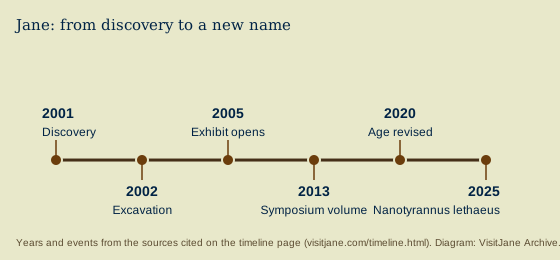
Each entry gives the date as precisely as the sources do. Where only a year is known, only the year is given. The list is a selection of the developments documented in the research for this site, not a complete bibliography; the page named in the last column covers the subject in detail.
| Date | What happened | Covered on |
|---|---|---|
| By 22 May 2006 | The Jane exhibit received the American Association of Museums' Exhibit Excellence Award and an honourable mention in the MUSE awards, as recorded in the Congressional Record of 22 May 2006.4 | The exhibit |
| August 2006 | More than 110 Triceratops bones from the museum's Montana dig site were due in Rockford on 21 August, according to the museum's press release.6 | Burpee Museum |
| 2008 | Michael Henderson and William Harrison published the study of how Jane was buried: 145 bones, about 52 percent of the skeleton, covered quickly by a mudflow.7 | The skeleton |
| October 2008 | A University of Leicester release dated 27 October said a cast of Jane's skeleton would be unveiled there on 29 October.8 | The skeleton |
| November 2009 | Joseph Peterson and colleagues described four partly healed bite wounds on Jane's face, which they attributed to another young tyrannosaur of about Jane's size.10 | Vital Statistics: injuries |
| 2011 | A study that laser-scanned the Leicester cast estimated Jane's body mass at 639 to 1,269 kg.11 | Vital Statistics: weight |
| 2013 | Tyrannosaurid Paleobiology was published, the volume from the symposium held for the opening of the Jane exhibit. It includes chapters on dating the Jane site, on an abscess in a toe bone and on the life reconstruction of Jane.12 | Timeline |
| 29 May 2013 | The museum's blog announced that its exhibit on the Triceratops Homer would open in exactly one month. The posts read for this site were written before the opening, and the actual date was not confirmed.13 | Burpee Museum |
| June 2015 | Ten years after the opening, a public radio report said that half a million visitors had seen Jane.14 | The exhibit |
| 2019 | Peterson and Daus matched bite marks on an Edmontosaurus tail bone to teeth of the size and spacing of Jane's. The bite was not made by Jane itself.15 | Vital Statistics: diet |
| 1 January 2020 | Holly Woodward and colleagues counted growth marks in Jane's leg bones, put the age at death at 13 years or more, and concluded that their results supported treating Nanotyrannus as young Tyrannosaurus, while leaving open that Nanotyrannus is valid and known only from young animals.16 | Vital Statistics: age |
| 20 March 2020 | The Bureau of Land Management, which manages the land Jane came from, published a post titled "It's settled! Jane was a juvenile, not another species".17 | Is Jane a Nanotyrannus? |
| 4 June 2020 | Thomas Carr published a growth series for T. rex built from 1,850 anatomical characters and 44 specimens. It treats Jane as a juvenile T. rex.39 | Is Jane a Nanotyrannus? |
| 2021 | Peterson, Tseng and Brink estimated the force of the bite that wounded Jane at 5,269 to 5,641 newtons.18 | Vital Statistics: teeth and bite |
| 2022 | The museum marked 20 years since Jane was excavated and brought to Rockford.19 | Journey |
| 3 January 2024 | Nicholas Longrich and Evan Saitta argued that Nanotyrannus is a separate animal, differing from T. rex in more than 150 features.20 | Is Jane a Nanotyrannus? |
| 2024 to 2025 | The pterosaur neck bone found in Jane's quarry was named as a new animal, Infernodrakon hastacollis. The paper carries a 2024 journal date; a co-author announced it in March 2025.21 | Cretaceous Period |
| 30 October 2025 | Lindsay Zanno and James Napoli published "Nanotyrannus and Tyrannosaurus coexisted at the close of the Cretaceous" in Nature. The paper describes another fossil, the tyrannosaur of the "Dueling Dinosaurs", concludes that Nanotyrannus is distinct from Tyrannosaurus, and names Jane the type specimen of a second species, Nanotyrannus lethaeus.22 | Is Jane a Nanotyrannus? |
| 30 October 2025 | Thomas Carr accepted that the Dueling Dinosaurs animal is a small adult, but told Live Science: "I have a different way of looking at the evidence and that is that Jane is a juvenile T. rex."23 | Is Jane a Nanotyrannus? |
| By 3 November 2025 | Local news reports in Rockford covered the renaming and quoted a museum news release. The wording was conditional. Joshua Mathews, named in the reports as the museum's head of paleontology, said: "If Jane is truly Nanotyrannus lethaeus, she's the only one of her kind ever found".24,36 | The exhibit |
| By 6 December 2025 | The museum's Jane page announced that Jane "may not be a T. rex after all". An archived copy of 6 December 2025 carries the heading "Jane: NOT a juvenile Tyrannosaur??".25 | The exhibit |
| 4 December 2025 | Christopher Griffin and colleagues reported online in Science that the original Nanotyrannus skull in Cleveland came from an animal at or near full maturity. The study is about that skull, not about Jane.26 | Is Jane a Nanotyrannus? |
| 13 December 2025 | Sancarlo and Paul posted a preprint that would move Jane's species into a new genus. It has not been peer reviewed.30 | Is Jane a Nanotyrannus? |
| 14 January 2026 | Woodward, Myhrvold and Horner found that the growth records of Jane and the second Burpee tyrannosaur are statistically incompatible with the other Tyrannosaurus in their sample, and wrote that this "cannot explain why they differ or how they should be classified."27 | Vital Statistics: identity |
| 30 January 2026 | Nature issued a correction to the Zanno and Napoli paper. It changed the copyright line only.28 | Is Jane a Nanotyrannus? |
| 17 February 2026 | A paper by Wyenberg-Henzler and Scannella on a bitten Edmontosaurus skull referred to two species of Nanotyrannus in the Hell Creek Formation, citing Zanno and Napoli.29 | Is Jane a Nanotyrannus? |
| 6 to 8 March 2026 | The Burpee Museum's PaleoFest was built around the renaming, with James Napoli giving the opening talk on Friday 6 March. The museum's press release expected nearly 2,000 visitors; no attendance figure after the event was found.31,32 | Burpee Museum |
| 12 March 2026 | Longrich and colleagues called Jane the holotype of "Nanotyrannus" lethaeus, with the genus name in quotation marks.37 | Is Jane a Nanotyrannus? |
| 20 May 2026 | A dating study gave the first direct ages for the lower Hell Creek Formation, about 66.9 million years for the level of the Dueling Dinosaurs in central Montana. It does not date Jane's own site.33 | Cretaceous Period |
| 7 July 2026 | A further paper by Longrich and colleagues listed Jane's species with a question mark over its genus and called the number of such species unclear.38 | Is Jane a Nanotyrannus? |
Where things stand in October 2026
Jane is on display at the Burpee Museum, which lists the exhibit among its current first-floor exhibits.1 The museum's own wording is mixed: its exhibit page still describes a juvenile T. rex, while its 2026 festival material presents Jane as the type specimen of Nanotyrannus lethaeus.34,32 Whether the labels in the gallery have changed could not be established.


The scientific question is open in a narrower form than before. The specialists quoted in the sources read for this site broadly accept that the Dueling Dinosaurs fossil is a small adult tyrannosaur and not a young T. rex. Whether Jane belongs with it is still disputed, and Jane's new species rests on one skeleton that had not finished growing.22,23 A full description of Jane's skeleton by Thomas Carr and colleagues was listed as in preparation in the 2025 paper's supplement. No publication of it, and no peer-reviewed paper since October 2025 arguing specifically that Jane is a T. rex, was found.22
Related pages: Is Jane a Nanotyrannus? · Vital Statistics · Timeline · Where Jane lives · Discovery
Sources
- Burpee Museum of Natural History. "Highway To Hell Creek", "Visit Burpee" and "First Floor Exhibits" (web pages). burpee.org/highway-to-hell-creek, burpee.org/visit-burpee, burpee.org/first-floor. Accessed 5 October 2026.
- Burpee Museum of Natural History. "Expeditions FAQ" (web page). burpee.org/expeditions-faq. Accessed 5 October 2026.
- Burghart, T. (2005). "Junior fossil find puts small museum on map." Associated Press, in the Lawrence Journal-World, 26 July 2005. ljworld.com
- Manzullo, D. A. (2006). "In Honor of Rockford, IL, Burpee Museum for Receiving Two American Association of Museum Awards." Congressional Record 152(64), Extensions of Remarks, 22 May 2006, p. E922. govinfo.gov
- Advanced Computing Center for the Arts and Design, The Ohio State University. "Jane: Diary of a Dinosaur" (project page). accad.osu.edu
- Burpee Museum of Natural History (2006). "The Triceratops are coming to Rockford!" Press release, August 2006 (PDF, archived 1 July 2007). web.archive.org
- Henderson, M. D. & Harrison, W. H. (2008). Taphonomy and environment of deposition of a juvenile tyrannosaurid skeleton from the Hell Creek Formation (latest Maastrichtian) of southeastern Montana. In Larson & Carpenter (eds), Tyrannosaurus rex, the Tyrant King, Indiana University Press, pp. 82–90.
- University of Leicester (2008). "Iconic T.rex to be Unveiled at University of Leicester." Release published by Phys.org, 27 October 2008. phys.org. Read through an automated text extraction.
- "Terrible Teens Of T. Rex: Young Tyrannosaurs Did Serious Battle Against Each Other." ScienceDaily, from Northern Illinois University materials, 2 November 2009. sciencedaily.com
- Peterson, J. E., Henderson, M. D., Scherer, R. P. & Vittore, C. P. (2009). Face biting on a juvenile tyrannosaurid and behavioral implications. PALAIOS 24(11): 780–784. doi:10.2110/palo.2009.p09-056r
- Hutchinson, J. R., Bates, K. T., Molnar, J., Allen, V. & Makovicky, P. J. (2011). A computational analysis of limb and body dimensions in Tyrannosaurus rex with implications for locomotion, ontogeny, and growth. PLoS ONE 6(10): e26037. doi:10.1371/journal.pone.0026037
- Parrish, J. M., Molnar, R. E., Currie, P. J. & Koppelhus, E. B. (eds) (2013). Tyrannosaurid Paleobiology. Indiana University Press. iupress.org
- Burpee Museum of Natural History (2013). "30 Days to Homer." No Stone Unturned (museum blog), 29 May 2013. blogburpee.wordpress.com
- "How To Throw A Party For A Young Dinosaur." Northern Public Radio (WNIJ), 26 June 2015. northernpublicradio.org
- Peterson, J. E. & Daus, K. N. (2019). Feeding traces attributable to juvenile Tyrannosaurus rex offer insight into ontogenetic dietary trends. PeerJ 7: e6573. doi:10.7717/peerj.6573
- Woodward, H. N., Tremaine, K., Williams, S. A., Zanno, L. E., Horner, J. R. & Myhrvold, N. P. (2020). Growing up Tyrannosaurus rex: Osteohistology refutes the pygmy "Nanotyrannus" and supports ontogenetic niche partitioning in juvenile Tyrannosaurus. Science Advances 6(1): eaax6250, 1 January 2020. doi:10.1126/sciadv.aax6250
- Bureau of Land Management (2020). "It's settled! Jane was a juvenile, not another species." Blog post, 20 March 2020. blm.gov
- Peterson, J. E., Tseng, Z. J. & Brink, S. (2021). Bite force estimates in juvenile Tyrannosaurus rex based on simulated puncture marks. PeerJ 9: e11450. doi:10.7717/peerj.11450
- Burpee Museum of Natural History (2022). "Jane Un-Earthed Day" (web page, archived 26 June 2022). web.archive.org
- Longrich, N. R. & Saitta, E. T. (2024). Taxonomic status of Nanotyrannus lancensis (Dinosauria: Tyrannosauroidea), a distinct taxon of small-bodied tyrannosaur. Fossil Studies 2(1): 1–65, 3 January 2024. doi:10.3390/fossils2010001
- Thomas, H., Hone, D. W. E., Gomes, T. & Peterson, J. E. (2024). Infernodrakon hastacollis gen. et sp. nov., a new azhdarchid pterosaur from the Hell Creek Formation of Montana, and the pterosaur diversity of Maastrichtian North America. Journal of Vertebrate Paleontology. doi:10.1080/02724634.2024.2442476. Announcement: Hone, D., "Welcome Infernodrakon – a new azhdarchid", Archosaur Musings, 4 March 2025. archosaurmusings.wordpress.com
- Zanno, L. E. & Napoli, J. G. (2025). Nanotyrannus and Tyrannosaurus coexisted at the close of the Cretaceous. Nature 648: 357–367, published 30 October 2025, with Supplementary Information. doi:10.1038/s41586-025-09801-6
- Simms, C. (2025). "Nanotyrannus isn't a 'mini T. Rex' after all — it's a new species, 'dueling dinosaurs' fossil reveals." Live Science, 30 October 2025. livescience.com
- "Rockford's famous 'Jane' dinosaur identified as new species in study." WIFR, 31 October 2025. wifr.com
- Burpee Museum of Natural History. "Jane" (web page headed "Jane: NOT a juvenile Tyrannosaur??"). burpee.org/jane, accessed 5 October 2026; archived copy of 6 December 2025 at web.archive.org.
- Griffin, C. T., Bugos, J., Poust, A. W., Morris, Z. S., Sombathy, R. S., D'Emic, M. D., O'Connor, P. M., Petermann, H., Fabbri, M. & Colleary, C. (2026). A diminutive tyrannosaur lived alongside Tyrannosaurus rex. Science 391(6782): 300–305, first published online 4 December 2025. doi:10.1126/science.adx8706
- Woodward, H. N., Myhrvold, N. P. & Horner, J. R. (2026). Prolonged growth and extended subadult development in the Tyrannosaurus rex species complex revealed by expanded histological sampling and statistical modeling. PeerJ 14: e20469, 14 January 2026. doi:10.7717/peerj.20469
- Publisher Correction: Nanotyrannus and Tyrannosaurus coexisted at the close of the Cretaceous. Nature, 30 January 2026. doi:10.1038/s41586-026-10185-4
- Wyenberg-Henzler, T. C. A. & Scannella, J. B. (2026). Behavioral implications of an embedded tyrannosaurid tooth and associated tooth marks on an articulated skull of Edmontosaurus from the Hell Creek Formation, Montana. PeerJ 14: e20796, 17 February 2026. doi:10.7717/peerj.20796
- Sancarlo, F. & Paul, G. S. (2025). The taxonomics of the diverse, lithe basal eutyrannosaur genera and species of late Maastrichtian western North America. bioRxiv preprint, first version 13 December 2025, not peer reviewed. doi:10.64898/2025.12.10.693447
- Burpee Museum of Natural History (2026). "PaleoFest" and "PaleoFest Lectures" (web pages). burpee.org/paleofest, burpee.org/paleofest/lectures. Accessed 5 October 2026.
- Burpee Museum of Natural History (2026). PaleoFest media kit, with the press release "Jane's True Identity Revealed". burpee.org/paleofest/media-kit. Accessed 5 October 2026.
- Roberts, E. M., Hendrix, M. S., Ramezani, J., Clyde, W. C., Zippi, P., Hodgson, S., Yuleridge, V. & Zanno, L. E. (2026). A high precision CA-ID-TIMS U-Pb zircon age for the "Dueling Dinosaurs" locality, with implications for regional correlation, basal age and duration of the Hell Creek Formation, Montana. PLOS One 21(5): e0328861, 20 May 2026. doi:10.1371/journal.pone.0328861
- Burpee Museum of Natural History. "Jane: Diary Of A Dinosaur" (exhibit page). burpee.org/jane-diary-of-a-dinosaur. Accessed 5 October 2026.
- Burpee Museum of Natural History. "Meet 'Jane' the Dinosaur." Museum website as archived on 1 October 2002. web.archive.org
- Haas, K. (2025). "New study says Rockford's Jane is a new species, not a juvenile T-rex." Rock River Current, 3 November 2025. Quotes the Burpee Museum's news release. rockrivercurrent.com
- Longrich, N. R., Dalman, S., Lucas, S. G. & Fiorillo, A. R. (2026). A large tyrannosaurid from the Late Cretaceous (Campanian) of North America. Scientific Reports 16: 8371, 12 March 2026. doi:10.1038/s41598-026-38600-w
- Longrich, N. R., Makovicky, P. J., Tokaryk, T., Cooper, D. M. L., Saitta, E. T., Erickson, G. M., Szekely, T. & Snively, E. (2026). Hatchlings of Tyrannosaurus rex and the evolution of dinosaur reproductive strategies. Biology 15(13): 1090, 7 July 2026. doi:10.3390/biology15131090
- Carr, T. D. (2020). A high-resolution growth series of Tyrannosaurus rex obtained from multiple lines of evidence. PeerJ 8: e9192, 4 June 2020. doi:10.7717/peerj.9192