

Jane timeline: 1942 to 2026
Last updated 7 October 2026 · 52 sources
Jane was found in Montana in 2001, excavated and brought to Rockford in 2002, put on display in 2005 and named as the type specimen of Nanotyrannus lethaeus in 2025.6,7,14,36 The story of that name starts earlier, with a skull collected in the same Montana county in 1942.1
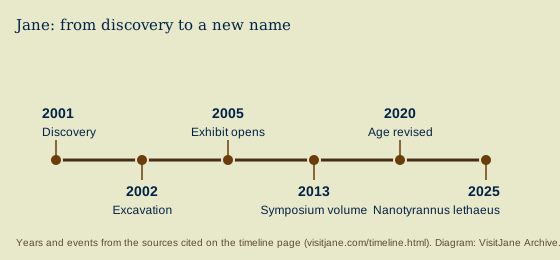
Each entry below rests on a published source, and most link to the page that covers the event in more depth. Dates are as precise as the sources are. Where a source gives only a year, the entry gives only the year. Where a journal paper has one date for online publication and another for the printed issue, the entry uses the online date and says so.
Sections: the Cleveland skull · discovery and excavation · preparation and exhibit · studies of the skeleton · the species question · the museum's response · dates that could not be established
The Cleveland skull, 1942 to 2004

.jpg)
Jane's disputed identity depends on a different fossil, a skull held by the Cleveland Museum of Natural History. The full account is on the page Is Jane a Nanotyrannus?
| Date | Event |
|---|---|
| 16 August 1942 | David Dunkle of the Cleveland Museum of Natural History collects a tyrannosaur skull at Sand Creek, Carter County, Montana. Jane was later found in the same county.1,2 |
| 1946 | Charles Gilmore describes the skull as a new species, Gorgosaurus lancensis, and judges it to be an adult from its fused skull sutures.1 |
| 1965 | Rozhdestvensky proposes that the Cleveland skull is a young Tyrannosaurus rex, as reported in a 2020 paper that reviews the history.3 |
| 1988 | Robert Bakker, Michael Williams and Philip Currie give the skull its own genus, Nanotyrannus, and read it as an adult, as later summarised by Woodward and colleagues.4,3,2 |
| 1999 | Thomas Carr publishes a study of how tyrannosaur skulls change with growth. Later authors cite it as a basis for reading the Cleveland skull as a juvenile T. rex. Only the bibliographic record of this paper was read for this site.3,5 |
| 2004 | Carr and Williamson formally merge Nanotyrannus into Tyrannosaurus.3 |
Discovery and excavation, 2001 to 2002

.jpg)
| Date | Event |
|---|---|
| 2001 | A Burpee Museum expedition, surveying with the permission of the Bureau of Land Management, finds foot and lower leg bones of a meat-eating dinosaur weathering out of the Hell Creek Formation in Carter County, Montana.6 The finders are Carol Tuck and Bill Harrison, on the last day of the expedition.7 The museum's permit covers surface exploration only, so the site is covered and its position recorded.7 No source read for this site gives the day or month. More: Discovery. |
| May 2002 | Museum staff and volunteers return with an excavation permit.7 More: Excavation. |
| July 2002 | The skull is found, according to a fossil club's write-up of a talk given that November by a volunteer who had been on the dig.8 |
| 7 August 2002 | The Associated Press reports that the skeleton is still in a block of rock, due to be loaded on a truck that Wednesday. The expedition leader, Michael Henderson, tells the agency: "Any interpretation while the specimen is still in the ground is a bit premature".9 |
| 10 August 2002 | Jane arrives at the Burpee Museum in a Woods Equipment semi-trailer. About 150 people meet the truck, among them Rockford's mayor, Doug Scott.7,10 More: Journey to Rockford. |
| By 1 October 2002 | The museum presents the find as a Nanotyrannus. A page on its website, archived on that date, reports Robert Bakker's statement that the skeleton is a Nanotyrannus and quotes Peter Larson calling it an adult.11 |
Preparation and exhibit, 2002 to 2006


| Date | Event |
|---|---|
| 2002 | Preparators begin removing the rock from the bones. The museum's 2005 account says the work was headed by Scott Williams and took more than 18 months and 10,000 hours.12 Williams's later staff profile at another museum gives 2003 as the year the Burpee Museum hired him as fossil lab manager.13 More: Preparation. |
| 2003 | Gregory Erickson reads Jane's age at death as 11 years from thin sections of a rib, a fibula (the thin bone of the lower leg) and a foot bone. The figure reached print in 2008 as a personal communication dated 2003.6 More: Age. |
| January 2005 | The Burpee Museum, the Advanced Computing Center for the Arts and Design at The Ohio State University and Engine Studios of Rockford begin work on the exhibit's animation and touchscreen media, funded by the Institute of Museum and Library Services.14 |
| 29 June 2005 | The permanent exhibit "Jane: Diary of a Dinosaur" opens. The exact day comes from the Ohio State project page; a statement in the Congressional Record says June 2005.14,15 A radio retrospective ten years later put the opening crowd at 3,000.16 The mount, by Research Casting International, uses the original fossil bones with the missing ones reconstructed.17 The skull on the mount is a cast of a reconstruction by the artist Tyler Keillor; the museum holds 23 original skull bones.12,49 More: Where Jane lives. |
| July 2005 | The Associated Press reports that Henderson, after three years of study and visits to other museums, has decided Jane is a juvenile T. rex.18 A university release of November 2009 dates his announcement to 2006.52 |
| 2005 | The exhibit opening is the occasion for an international symposium on tyrannosaurs. A bibliography on a specialist blog gives its title as "The origin, systematics, and paleobiology of Tyrannosauridae" and its hosts as the Burpee Museum and Northern Illinois University, and lists a presentation by Philip Currie and colleagues on tyrannosaur teeth and the status of Nanotyrannus lancensis.19,20 The dates of the meeting could not be confirmed. |
| 2006 | The exhibit receives the American Association of Museums' Exhibit Excellence Award and a MUSE Award honourable mention for one of its videos. Lew Crampton, the museum's president, accepts them at the association's conference in Boston. The year is taken from the Congressional Record statement of 22 May 2006 that reports the awards.15 |
| 2006 | Jane's skull and teeth are used in a study of skull and tooth strength by Snively, Henderson and Phillips. This entry relies on a later paper's citation of that study, which was not itself read.21 |
Studies of the skeleton, 2008 to 2021
These studies did not all describe Jane the same way, and each entry keeps the study's own framing. The two earliest, in 2008 and 2009, say only "juvenile tyrannosaurid". Most of the later ones treat Jane as a juvenile Tyrannosaurus rex. Two papers of 2015 and 2016 treat it as Nanotyrannus.6,24,26,28 The measurements themselves are set out on Vital Statistics and The skeleton.
| Date | Event |
|---|---|
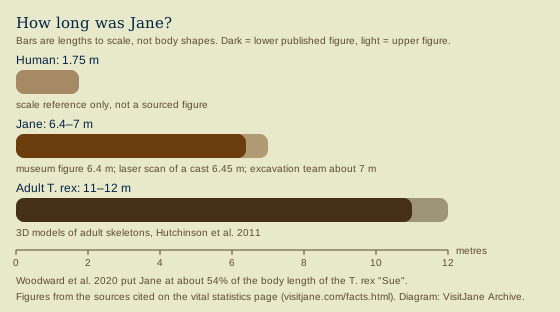
| 2008 | Burial study. Michael Henderson and William Harrison publish the excavators' account: 145 bones, about 52 percent of the skeleton, collected from an area of 4 square metres; a juvenile tyrannosaurid, in the paper's words, about 7 m long and lying on its right side; rapid burial by a mudflow as the reason so much of it survived.6 |
| October 2008 | A University of Leicester release dated 27 October announces a cast of Jane for the university, made by Research Casting International, and names casts at two museums in the United States as the only others at that time.22 The Leicester cast was later laser-scanned for the 2011 body mass study.23 |
| November 2009 | Bite marks. Joseph Peterson, Michael Henderson, Reed Scherer and Christopher Vittore describe four partly healed wounds on the left upper jaw and nasal bones of what they call a juvenile tyrannosaurid. They speculate, and use that word, that the wounds came from a fight over territory or rank with another young tyrannosaur.24 More: Injuries. |
| 2011 | Body mass. J. R. Hutchinson and colleagues build three-dimensional models on the scanned cast, which they treat as a juvenile T. rex, and estimate 639 to 1,269 kg, with an average of 954 kg.23 More: Weight. |
| 2013 | Symposium volume. Tyrannosaurid Paleobiology, the book from the 2005 meeting, is published by Indiana University Press. It includes Peter Larson's chapter "The Case for Nanotyrannus" and chapters on dating the Jane site, on an abscess in a tyrannosaur toe bone and on Jane's life reconstruction.19 |
| 2013 | The museum is approached by the promoters of a dinosaur exhibition in Osaka, Japan, and part of Jane's bitten upper jaw travels there for a short time, according to a Bureau of Land Management release of 2016.25 |
| June 2015 | Ten years after the opening, a public radio report says half a million people have visited Jane.16 |
| 2015 to 2016 | The jaw groove exchange. J. D. Schmerge and B. M. Rothschild argue in Cretaceous Research that a groove along Jane's lower jaw, which they say T. rex lacks, marks a separate genus, Nanotyrannus. Their paper appeared online in 2015, the date used here, in a volume dated 2016.26 Steve Brusatte, Thomas Carr and colleagues reply in the same journal in 2016 that such a groove is what a young T. rex should have.27 |
| 2016 | W. S. Persons and Philip Currie score leg proportions in meat-eating dinosaurs. Jane's score of 35.8 is above the range of the other tyrannosaurs in their data. The authors grouped Jane with Nanotyrannus and read the score as support for that genus, while noting that no clearly identified juvenile T. rex with different leg proportions was known.28 More: Legs. |
| 2019 | E. Snively and colleagues, who list Jane as a juvenile T. rex, estimate its mass at 575 to 654 kg. In the 300 to 700 kg range they find young tyrannosaurs two to three times more agile at turning than adult allosauroids, another group of large meat-eaters, of similar weight.29 Peterson and Daus, also writing of a juvenile T. rex, match bite marks on a duck-billed dinosaur's tail bone to the size and spacing of Jane's teeth; the bite was not made by Jane itself.30 |
| 1 January 2020 | Bone histology. Holly Woodward and colleagues publish thin sections of the leg bones of Jane and of a second, more fragmentary Burpee tyrannosaur, BMRP 2006.4.4. Jane was at least 13 years old and the second animal at least 15. The authors conclude that the results support merging Nanotyrannus into Tyrannosaurus, while leaving open that Nanotyrannus is valid and known only from young animals.3 |
| 20 March 2020 | The Bureau of Land Management, which manages the land Jane came from, reports the study under the headline "It's settled! Jane was a juvenile, not another species".31 |
| 2020 | T. A. Dececchi and colleagues give Jane a lower cost of transport (1.73) than other predators in their table, such as a 1,500 kg Allosaurus (2.06). A lower figure means more economical movement.32 |
| 4 June 2020 | Growth series. Thomas Carr publishes a growth series for T. rex built from 1,850 anatomical characters and 44 specimens. It treats Jane as a juvenile T. rex.21 |
| 2021 | Peterson, Tseng and Brink press a metal copy of one of Jane's teeth into cow bone and estimate the bite that wounded Jane's face at 5,269 to 5,641 newtons. Their paper calls Jane a juvenile Tyrannosaurus.33 |
The species question, 2024 to 2026


Who holds which position is laid out on Is Jane a Nanotyrannus?, and the two readings are compared feature by feature on Nanotyrannus vs T. rex.
| Date | Event |
|---|---|
| 3 January 2024 | Nicholas Longrich and Evan Saitta argue that Nanotyrannus is a separate animal, differing from T. rex in more than 150 anatomical characters.34 |
| 30 June 2025 | Gregory Paul argues that many small Hell Creek tyrannosaurs cannot be young Tyrannosaurus because their hands are as large as, or larger than, those of big adults.35 |
| 30 October 2025 | The Nature paper. Lindsay Zanno and James Napoli describe the tyrannosaur of the "Dueling Dinosaurs" fossil, NCSM 40000, and conclude that Nanotyrannus is distinct from Tyrannosaurus, lies outside its family and contains two species. Jane becomes the holotype, the single reference specimen, of the second species, Nanotyrannus lethaeus.36 The date is that of online publication; the paper is in volume 648 of the journal, pages 357 to 367. |
| 30 October 2025 | Reactions are published the same day. Thomas Carr tells Live Science: "I have a different way of looking at the evidence and that is that Jane is a juvenile T. rex".37 Steve Brusatte says it is very hard to tell whether Jane is a Nanotyrannus or a juvenile T. rex.37 |
| 4 December 2025 | Hyoid study. Christopher Griffin and colleagues report in Science that the microscopic structure of a throat bone from the Cleveland skull indicates an animal at or near skeletal maturity. The study concerns the Cleveland skull and does not examine Jane. The date is that of first online publication; the printed issue is dated 15 January 2026.39,2 |
| 13 December 2025 | Sancarlo and Paul post a preprint that would move Jane's species into a new genus. It has not been peer reviewed, and two records of the same preprint give different names for the proposed genus, so no name is repeated here.40 |
| 14 January 2026 | Woodward, Nathan Myhrvold and John Horner publish a larger study of tyrannosaur bone growth. The growth of both Burpee specimens is "statistically incompatible" with the other Tyrannosaurus in their data, a result that in their words "cannot explain why they differ or how they should be classified". They treat a separate species as one possible explanation.41 |
| 15 January 2026 | A commentary in Science by Andrew Farke carries the summary line "Multipronged approaches resolve the debate about the Nanotyrannus fossil species." Only that line was read for this site. It concerns the genus, not Jane's species.42 |
| 30 January 2026 | Nature issues a correction to the Zanno and Napoli paper. It changes the copyright line only.43 |
| 17 February 2026 | A paper by Wyenberg-Henzler and Scannella on a bitten Edmontosaurus skull refers to two species of Nanotyrannus in the Hell Creek Formation.44 |
| 12 March 2026 | Longrich and colleagues call Jane the holotype of "Nanotyrannus" lethaeus, with the genus name in quotation marks.46 |
| 7 July 2026 | A further paper by Longrich and colleagues lists Jane's species with a question over its genus and calls the number of such species unclear.47 |
As of 5 October 2026, the research for this site had found no peer-reviewed paper published after the Nature study that argues specifically that Jane is a T. rex. A detailed description of Jane's skeleton by Carr and colleagues, listed as in preparation in 2025, had not been found in print either.36
The Burpee Museum's response, 2025 to 2026


| Date | Event |
|---|---|
| By 3 November 2025 | Local news reports quote a museum news release and two of its officers. The wording is conditional. Joshua Mathews, named in the reports as the museum's head of paleontology, says: "If Jane is truly Nanotyrannus lethaeus, she's the only one of her kind ever found".50,51 |
| By 6 December 2025 | The museum's Jane page announces that Jane "may not be a T. rex after all". An archived copy of 6 December 2025 carries the heading "Jane: NOT a juvenile Tyrannosaur??".38 |
| 6 to 8 March 2026 | The museum's PaleoFest festival is built around the new name. James Napoli opens it on 6 March with a talk on Nanotyrannus lethaeus, and the museum's press material calls Jane the holotype of that species.45 |
| 5 October 2026 | On the date this page was last checked, the museum's wording was not uniform. Its Jane page gave both readings, including a sentence saying that most modern analyses support the juvenile T. rex view.38 Its exhibit page still described Jane as a juvenile T. rex.48 More: What the Burpee Museum says. |
Dates that could not be established
- The day and month of the 2001 discovery. The sources say only that it was the last day of that year's expedition.
- The dates of the 2005 symposium, and who spoke there apart from the one presentation listed above.
- When the original visitjane.com went online. See About this archive.
- Whether the labels in the exhibit itself were changed after October 2025. No museum statement on this was found.
Related pages: Discovery · Vital Statistics · Is Jane a Nanotyrannus? · Where Jane lives · About this archive
Sources
- Gilmore, C. W. (1946). A new carnivorous dinosaur from the Lance Formation of Montana. Smithsonian Miscellaneous Collections 106: 1–19. Read in the transcription by Plazi TreatmentBank.
- Cleveland Museum of Natural History (2025). "Research Spotlight: New Analysis of Nanotyrannus Holotype at Museum Leads to Breakthrough in Decades-Old Dinosaur Debate." Press release, 4 December 2025. cmnh.org
- Woodward, H. N., Tremaine, K., Williams, S. A., Zanno, L. E., Horner, J. R. & Myhrvold, N. P. (2020). Growing up Tyrannosaurus rex: Osteohistology refutes the pygmy "Nanotyrannus" and supports ontogenetic niche partitioning in juvenile Tyrannosaurus. Science Advances 6(1): eaax6250, 1 January 2020. doi:10.1126/sciadv.aax6250
- Bakker, R. T., Williams, M. & Currie, P. J. (1988). Nanotyrannus, a new genus of pygmy tyrannosaur, from the latest Cretaceous of Montana. Hunteria 1(5): 1–30. Genus heading read in the transcription by Plazi TreatmentBank.
- Carr, T. D. (1999). Craniofacial ontogeny in Tyrannosauridae (Dinosauria, Coelurosauria). Journal of Vertebrate Paleontology 19(3): 497–520. doi:10.1080/02724634.1999.10011161. Bibliographic record only.
- Henderson, M. D. & Harrison, W. H. (2008). Taphonomy and environment of deposition of a juvenile tyrannosaurid skeleton from the Hell Creek Formation (latest Maastrichtian) of southeastern Montana. In Larson & Carpenter (eds), Tyrannosaurus rex, the Tyrant King, Indiana University Press, pp. 82–90. Read in the text deposited at zenodo.org/records/4572551.
- Burpee Museum of Natural History. "Jane's Discovery." Museum website as archived on 3 April 2005. web.archive.org
- Earth Science Club of Northern Illinois (2020). "Throwback Thursday #31: The Nanotyrannus Find on the Burpee 2002 Montana Expedition." Reprints the club's write-up of a talk at its November 2002 meeting. esconi.org
- Associated Press (2002). "Museum dig team finds dinosaur fossil in Montana." Moline Dispatch & Rock Island Argus, 7 August 2002. qconline.com
- Burpee Museum of Natural History. "Jane's Journey to Rockford IL." Museum website as archived on 1 October 2002. web.archive.org
- Burpee Museum of Natural History. "Meet 'Jane' the Dinosaur." Museum website as archived on 1 October 2002. web.archive.org
- Burpee Museum of Natural History. "Jane's Skeleton." Museum website as archived on 3 April 2005. web.archive.org
- Museum of the Rockies, Montana State University. "Scott A. Williams." Staff profile. museumoftherockies.org. Accessed 5 October 2026.
- Advanced Computing Center for the Arts and Design, The Ohio State University. "Jane: Diary of a Dinosaur." Project page. accad.osu.edu. Accessed 5 October 2026.
- Manzullo, D. A. (2006). "In Honor of Rockford, IL, Burpee Museum for Receiving Two American Association of Museum Awards." Congressional Record, Extensions of Remarks, 22 May 2006, p. E922. govinfo.gov
- "How To Throw A Party For A Young Dinosaur." Northern Public Radio (WNIJ), 26 June 2015. northernpublicradio.org
- Research Casting International. "Jane the Tyrannosaurus Rex." Case study. rescast.com. Accessed 5 October 2026.
- Burghart, T. (2005). "Junior fossil find puts small museum on map." Associated Press, in the Lawrence Journal-World, 26 July 2005. ljworld.com
- Parrish, J. M., Molnar, R. E., Currie, P. J. & Koppelhus, E. B. (eds) (2013). Tyrannosaurid Paleobiology. Indiana University Press. Publisher's description and table of contents: iupress.org
- Cau, A. (2009). "Nanotyrannus, una storia di stratigrafia, ontogenesi e filogenesi." Theropoda blog, May 2009. Used only for its bibliography entry on the 2005 symposium. theropoda.blogspot.com
- Carr, T. D. (2020). A high-resolution growth series of Tyrannosaurus rex obtained from multiple lines of evidence. PeerJ 8: e9192, 4 June 2020. doi:10.7717/peerj.9192. The publisher's page could not be opened; this page relies on the abstract and on a text extraction deposited at zenodo.org/records/7535061.
- University of Leicester (2008). "Iconic T.rex to be Unveiled at University of Leicester." Release published by Phys.org, 27 October 2008. phys.org. Read through an automated text extraction.
- Hutchinson, J. R., Bates, K. T., Molnar, J., Allen, V. & Makovicky, P. J. (2011). A computational analysis of limb and body dimensions in Tyrannosaurus rex with implications for locomotion, ontogeny, and growth. PLoS ONE 6(10): e26037. doi:10.1371/journal.pone.0026037
- Peterson, J. E., Henderson, M. D., Scherer, R. P. & Vittore, C. P. (2009). Face biting on a juvenile tyrannosaurid and behavioral implications. PALAIOS 24(11): 780–784, 1 November 2009. doi:10.2110/palo.2009.p09-056r. This page relies on the abstract and on a text extraction deposited at zenodo.org/records/14627980.
- Bureau of Land Management (2016). "BLM: 2016 a good year for T. rex finds." Press release. blm.gov
- Schmerge, J. D. & Rothschild, B. M. (2016). Distribution of the dentary groove of theropod dinosaurs: Implications for theropod phylogeny and the validity of the genus Nanotyrannus Bakker et al., 1988. Cretaceous Research 61: 26–33 (online 2015). doi:10.1016/j.cretres.2015.12.016. Read in a text extraction deposited at zenodo.org/records/4715039.
- Brusatte, S. L., Carr, T. D., Williamson, T. E. & Holtz, T. R. Jr (2016). Dentary groove morphology does not distinguish 'Nanotyrannus' as a valid taxon of tyrannosauroid dinosaur. Cretaceous Research 65: 232–237. doi:10.1016/j.cretres.2016.02.007. Authors as given in the text deposit read for this site; a later paper's reference list adds two further authors.
- Persons, W. S. & Currie, P. J. (2016). An approach to scoring cursorial limb proportions in carnivorous dinosaurs and an attempt to account for allometry. Scientific Reports 6: 19828. doi:10.1038/srep19828
- Snively, E., O'Brien, H., Henderson, D. M., Mallison, H., Surring, L. A. et al. (2019). Lower rotational inertia and larger leg muscles indicate more rapid turns in tyrannosaurids than in other large theropods. PeerJ 7: e6432. doi:10.7717/peerj.6432
- Peterson, J. E. & Daus, K. N. (2019). Feeding traces attributable to juvenile Tyrannosaurus rex offer insight into ontogenetic dietary trends. PeerJ 7: e6573. doi:10.7717/peerj.6573
- Bureau of Land Management (2020). "It's settled! Jane was a juvenile, not another species." Blog post, 20 March 2020. blm.gov
- Dececchi, T. A., Mloszewska, A. M., Holtz, T. R. Jr, Habib, M. B. & Larsson, H. C. E. (2020). The fast and the frugal: Divergent locomotory strategies drive limb lengthening in theropod dinosaurs. PLoS ONE 15(5): e0223698. doi:10.1371/journal.pone.0223698
- Peterson, J. E., Tseng, Z. J. & Brink, S. (2021). Bite force estimates in juvenile Tyrannosaurus rex based on simulated puncture marks. PeerJ 9: e11450. doi:10.7717/peerj.11450
- Longrich, N. R. & Saitta, E. T. (2024). Taxonomic status of Nanotyrannus lancensis (Dinosauria: Tyrannosauroidea), a distinct taxon of small-bodied tyrannosaur. Fossil Studies 2(1): 1–65, 3 January 2024. doi:10.3390/fossils2010001. The publisher's page could not be opened; this page relies on the abstract.
- Paul, G. S. (2025). A presentation of the current data on the exceptionally diverse non-tyrannosaurid eutyrannosaur and tyrannosaurini genera and species of western North America. Mesozoic 2(2): 085–138, 30 June 2025. doi:10.11646/mesozoic.2.2.1. Abstract only.
- Zanno, L. E. & Napoli, J. G. (2025). Nanotyrannus and Tyrannosaurus coexisted at the close of the Cretaceous. Nature 648: 357–367, published online 30 October 2025, with Supplementary Information. doi:10.1038/s41586-025-09801-6. The main text is behind a paywall; this page relies on the abstract, page metadata and the Supplementary Information.
- Simms, C. (2025). "Nanotyrannus isn't a 'mini T. Rex' after all — it's a new species, 'dueling dinosaurs' fossil reveals." Live Science, 30 October 2025. livescience.com
- Burpee Museum of Natural History. "Jane" (web page headed "Jane: NOT a juvenile Tyrannosaur??"). burpee.org/jane, accessed 5 October 2026; archived copy of 6 December 2025 at web.archive.org.
- Griffin, C. T., Bugos, J., Poust, A. W., Morris, Z. S., Sombathy, R. S., D'Emic, M. D., O'Connor, P. M., Petermann, H., Fabbri, M. & Colleary, C. (2026). A diminutive tyrannosaur lived alongside Tyrannosaurus rex. Science 391(6782): 300–305, first published online 4 December 2025. doi:10.1126/science.adx8706. Abstract only.
- Sancarlo, F. & Paul, G. S. (2025). The taxonomics of the diverse, lithe basal eutyrannosaur genera and species of late Maastrichtian western North America. bioRxiv preprint, first version 13 December 2025, not peer reviewed. doi:10.64898/2025.12.10.693447. Abstracts only.
- Woodward, H. N., Myhrvold, N. P. & Horner, J. R. (2026). Prolonged growth and extended subadult development in the Tyrannosaurus rex species complex revealed by expanded histological sampling and statistical modeling. PeerJ 14: e20469, 14 January 2026. doi:10.7717/peerj.20469
- Farke, A. A. (2026). Not a big baby. Science 391(6782): 234–235, 15 January 2026. doi:10.1126/science.aed8356. Summary line only.
- Publisher Correction: Nanotyrannus and Tyrannosaurus coexisted at the close of the Cretaceous. Nature, 30 January 2026. doi:10.1038/s41586-026-10185-4
- Wyenberg-Henzler, T. C. A. & Scannella, J. B. (2026). Behavioral implications of an embedded tyrannosaurid tooth and associated tooth marks on an articulated skull of Edmontosaurus from the Hell Creek Formation, Montana. PeerJ 14: e20796, 17 February 2026. doi:10.7717/peerj.20796
- Burpee Museum of Natural History (2026). PaleoFest 2026 festival page, lecture listing and media kit. burpee.org/paleofest, burpee.org/paleofest/lectures, burpee.org/paleofest/media-kit. Accessed 5 October 2026.
- Longrich, N. R., Dalman, S., Lucas, S. G. & Fiorillo, A. R. (2026). A large tyrannosaurid from the Late Cretaceous (Campanian) of North America. Scientific Reports 16: 8371, 12 March 2026. doi:10.1038/s41598-026-38600-w
- Longrich, N. R., Makovicky, P. J., Tokaryk, T., Cooper, D. M. L., Saitta, E. T., Erickson, G. M., Szekely, T. & Snively, E. (2026). Hatchlings of Tyrannosaurus rex and the evolution of dinosaur reproductive strategies. Biology 15(13): 1090, 7 July 2026. doi:10.3390/biology15131090
- Burpee Museum of Natural History. "Jane: Diary Of A Dinosaur." Exhibit page. burpee.org/jane-diary-of-a-dinosaur. Accessed 5 October 2026.
- Keillor, T. "'Jane' juvenile tyrannosaur skull." Artist's portfolio. tylerkeillor.com. Accessed 5 October 2026.
- Haas, K. (2025). "New study says Rockford's Jane is a new species, not a juvenile T-rex." Rock River Current, 3 November 2025. Quotes the Burpee Museum's news release. rockrivercurrent.com
- "Rockford's famous 'Jane' dinosaur identified as new species in study." WIFR, 31 October 2025. wifr.com
- "Terrible Teens Of T. Rex: Young Tyrannosaurs Did Serious Battle Against Each Other." ScienceDaily, from Northern Illinois University materials, 2 November 2009. sciencedaily.com