Since 30 October 2025 Jane has had a species name of its own: Nanotyrannus lethaeus. The study that coined it treats Jane as a young member of a small tyrannosaur that lived beside Tyrannosaurus rex, and not as a young T. rex.1 Several prominent former sceptics have since said on record that the fossil at the centre of that study is a small adult and not a young T. rex. Whether Jane belongs with it is still argued.
The short version. Two separate questions are often mixed together. Was there a small tyrannosaur called Nanotyrannus? Two studies published in late 2025 say yes, and several former sceptics agree that the key fossil is a small adult. Is Jane one of them? The 2025 paper says yes and gives Jane a new species. Thomas Carr, who is preparing the detailed description of Jane's skeleton, says Jane is a juvenile T. rex; others, including Holly Woodward Ballard and Steve Brusatte, say the case has not been made.
What is Nanotyrannus?
The name belongs to a skull collected by David Dunkle of the Cleveland Museum of Natural History on 16 August 1942 at Sand Creek in Carter County, Montana, the same county where Jane was found 59 years later.3,8 Charles Gilmore described it in 1946 as a new species, Gorgosaurus lancensis, and judged it an adult because many of the joins between its skull bones had fused.3
In 1988 Robert Bakker, Michael Williams and Philip Currie gave the skull a genus of its own, Nanotyrannus, and again read it as an adult.4,5 The skull is 572 mm long.5
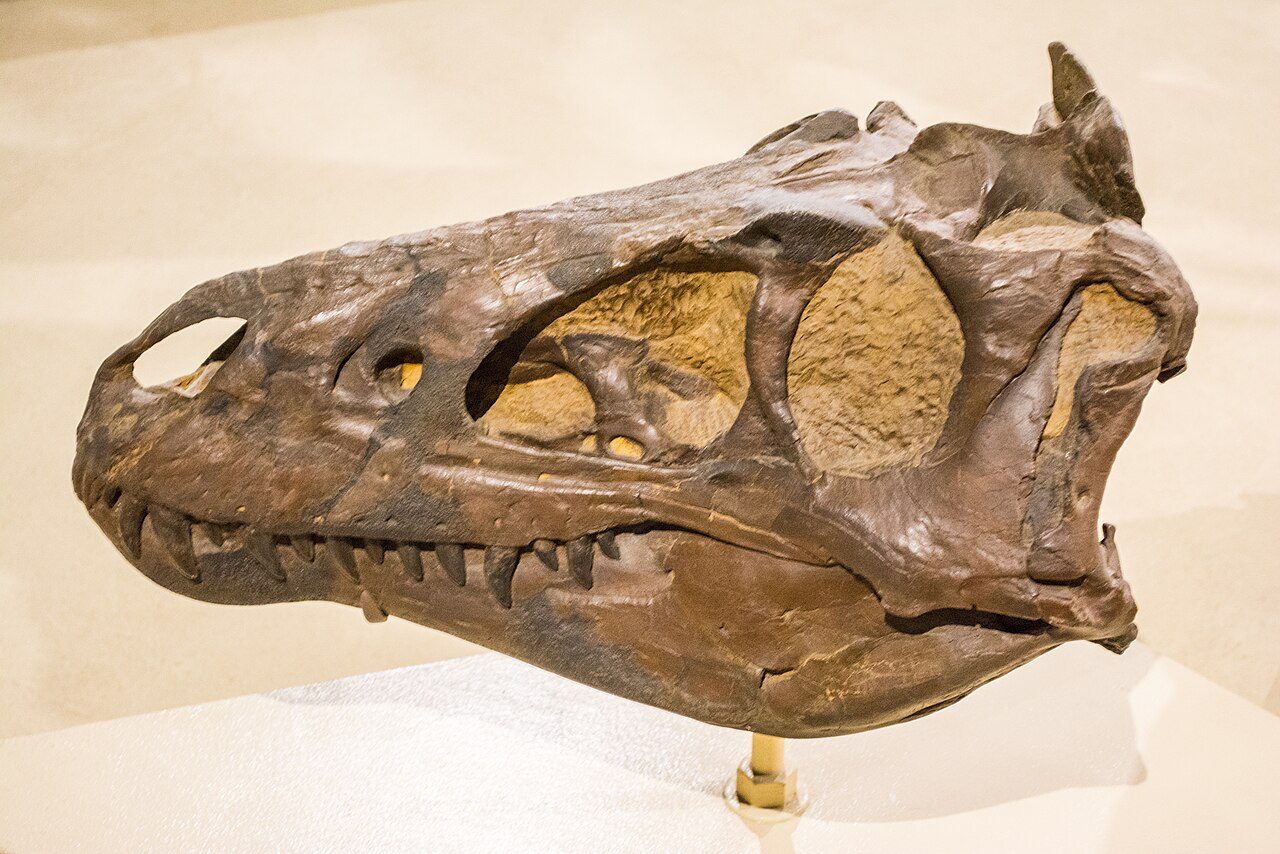
A cast of the Nanotyrannus lancensis skull on exhibit at the Cleveland Museum of Natural History. This is the Cleveland skull, not Jane. Photo (resized): Tim Evanson, CC BY-SA 2.0, via Wikimedia Commons.
The other reading: a young T. rex
The idea that the Cleveland skull is a juvenile Tyrannosaurus rex goes back to a proposal by Rozhdestvensky in 1965. In 2004 Thomas Carr and T. E. Williamson formally merged Nanotyrannus into Tyrannosaurus.5 By 2020 that was the majority view. A paper published that January described most tyrannosaur specialists as considering the skull, and the specimens linked to it, to be juvenile T. rex.5
Where Jane came in
Jane mattered to this argument from the start. The Burpee Museum says Jane was first thought to be a Nanotyrannus when the skeleton was discovered.14 The opening of the museum's Jane exhibit was the occasion for an international symposium on tyrannosaurs, and the book that came out of it in 2013 includes a chapter by Peter Larson titled "The Case for Nanotyrannus".19
The Cleveland specimen is only a skull. Jane has a skull and much of the body, and in 2020 was the only catalogued specimen with body bones that supporters of Nanotyrannus specifically assigned to it.5 So when Holly Woodward (who now also publishes as Holly Woodward Ballard) and colleagues wanted to test whether Nanotyrannus was a small adult, they cut into Jane's leg bones. They found an animal at least 13 years old that was still growing, and concluded that the results supported merging Nanotyrannus into Tyrannosaurus.5 The United States Bureau of Land Management, which manages the land Jane came from, headlined its report "It's settled!"18
The paper itself was more careful than the headline. It left open a second possibility: that Nanotyrannus is a real animal, and that every specimen then known, Jane included, happened to be young.5 What the bone sections showed was Jane's age, not Jane's species.
In 2024 Nicholas Longrich and Evan Saitta argued the opposite case at length, listing more than 150 anatomical differences between Nanotyrannus and T. rex.6
What changed in 2025
The 2025 paper is not mainly about Jane. Lindsay Zanno, who had been a co-author of the 2020 study, and James Napoli described a different fossil: the tyrannosaur of the "Dueling Dinosaurs" fossil from the Hell Creek Formation, catalogued as NCSM 40000.1,2 According to the university's summary of the study, growth rings, spinal fusion and developmental anatomy showed that this animal was about 20 years old and physically mature when it died.2 It was a small adult, which a young T. rex cannot be.
From that skeleton the authors drew three conclusions: Nanotyrannus can be told apart from Tyrannosaurus; it sits outside Tyrannosauridae, the family that contains T. rex; and it contains two species.1 The second species was the surprise. The paper's own summary calls it unexpected.
A second study, from a different team using a different method, followed five weeks later. Christopher Griffin and colleagues examined the microscopic structure of a throat bone from the original Cleveland skull and found that the animal was at or near full maturity.7,8 That study concerns the Cleveland skull. It does not examine Jane.
What the paper says about Jane
Zanno and Napoli compared the Dueling Dinosaurs tyrannosaur with other small Hell Creek tyrannosaurs and concluded that Jane was slightly different from it. They made Jane the holotype, the single reference specimen, of a new species, Nanotyrannus lethaeus.1,2 Jane is the only specimen assigned to it. The Burpee Museum's second small tyrannosaur, BMRP 2006.4.4, was judged too incomplete to place in either species.1
The species name refers to the River Lethe of Greek mythology, the river of forgetting. The university's announcement explains it as "a nod to how this species remained hidden in plain sight and 'forgotten' for decades."2
Three points are easy to miss in the news coverage:
Jane is still a juvenile. The authors agree the skeleton is immature, and write that no mature specimen of N. lethaeus exists from which to work out an adult weight.1 The paper changes Jane's species, not Jane's age.
The differences from the other species are small features of the skull and jaw. Where N. lancensis has a deep air pocket in a bone of the palate, Jane has a shallow hollow. Jane has a prong on the bone behind the eye that N. lancensis lacks. In N. lancensis the first two tooth sockets of the lower jaw are small; in Jane, as in T. rex, only the first is.1
Jane also shares a feature with the other Nanotyrannus specimens that the authors tentatively treat as unique to the genus: the lack of a small opening, visible from outside, below the nostril.1
The announcement from Napoli's university adds that N. lethaeus would have been slightly larger than N. lancensis as an adult.16 One measurement behind that: Jane's shin bone is 854 mm long against 782 mm in the Dueling Dinosaurs animal, 9.2 percent longer, although Jane was still growing.1 The material consulted for this page gives no adult length or weight.
Tooth counts: Nanotyrannus against T. rex
Jane
Nanotyrannus lancensis (Dueling Dinosaurs)
Tyrannosaurus rex, as counted by Zanno and Napoli
Teeth in each upper jaw bone
16
16 and 17
11 to 12
Teeth in each lower jaw
16 to 18 across Nanotyrannus
12 to 13
Counts from the Supplementary Information of Zanno and Napoli.1 Carr's growth series for T. rex has animals at Jane's stage with 16 upper and 17 lower positions, losing positions with age, which is how he explains Jane's count. For Jane's size and age see Vital Statistics.
Who accepts what
The reaction split along the line between the two questions. The statements below were all published on 30 October 2025, the day the paper appeared.
Researcher
Nanotyrannus is real?
Jane is N. lethaeus?
Thomas Carr, Carthage College
Accepts that the Dueling Dinosaurs animal is "a small adult tyrannosaur"; as paraphrased by Live Science, he would keep it inside the genus Tyrannosaurus9
No. "I have a different way of looking at the evidence and that is that Jane is a juvenile T. rex."9 To CNN the same day: "They've done strong work, but we must be cautious."20
Steve Brusatte, University of Edinburgh
Yes. "Evidence from this exquisite new specimen shows that I was wrong — at least in part."9
Unsure. Jane "clearly had not stopped growing, so I think it's frankly very hard to tell if this was a Nanotyrannus or a juvenile T. rex."9
Holly Woodward Ballard, Oklahoma State University
Accepts that the Dueling Dinosaurs animal was near adult size11
Not convinced that Jane is a new species, or a Nanotyrannus at all11
Thomas Holtz, University of Maryland
Yes. A former doubter, he said the study had "done a far better job advocating for [it] than anyone in the past."11
Yes, as paraphrased by Live Science: unless new finds show otherwise, the differences are enough to justify two species9
Lawrence Witmer, Ohio University, who was one of the paper's reviewers
Yes. He called the outcome "clear and about as definitive as we can get in paleontology—Nanotyrannus is real."12
Not addressed in the statement quoted
Carr is the lead author of a detailed description of Jane's skeleton that the 2025 paper lists as in preparation.1 As of the date at the top of this page, the research for this site had found neither that description nor any peer-reviewed reply defending Jane as T. rex in print.
Since the paper
In January 2026 Woodward, Nathan Myhrvold and John Horner published a larger study of tyrannosaur bone growth. It found that the growth of both small Burpee tyrannosaurs is "statistically incompatible" with that of the other Tyrannosaurus specimens in their data. The authors did not take that as proof of a separate species. Such a result, they wrote, "cannot explain why they differ or how they should be classified", and they named a different species as one possible explanation among several.13
Other teams have begun using the new name. A February 2026 paper on a bitten Edmontosaurus skull refers to two species of Nanotyrannus in the Hell Creek Formation.15 Longrich and colleagues, writing in March 2026, call Jane the holotype of "Nanotyrannus" lethaeus, with the genus in quotation marks, which signals doubt about its place in that genus.10 A preprint that has not been peer reviewed goes further and proposes a new genus for Jane.17
So the disagreement now runs in two directions. Some researchers think Jane is a young T. rex after all. Others accept that Jane is not T. rex and question which genus it belongs in.
What the Burpee Museum says
The museum that holds Jane presents both readings, and its page is not consistent. The Jane page is headed with a question, "Jane: NOT a juvenile Tyrannosaur??", and says Jane "may not be a T. rex after all".14 The same page, as read on 5 October 2026, still carries an older sentence saying that most modern analyses support the juvenile T. rex view, alongside a newer one saying the paper "ends the debate about the validity of Nanotyrannus lancensis!"14 The museum's executive director, Anne Weerda, put it this way: "Whether Jane represents the best-preserved juvenile T. rex or the only known specimen of a brand-new species, she is truly one of a kind — and she calls Rockford home."14
What would settle it
The researchers quoted above point to two gaps. The first is an adult: no mature specimen of N. lethaeus is known,1 and CNN reported Carr as saying that fresh fossils are needed to understand how the two species differ.20
The second is an agreed young T. rex to compare Jane with. Zanno and Napoli point to one small specimen about Jane's size that they identify as T. rex.1 Holtz stated the wider problem to Science News: "If Nanotyrannus is real, and it looks like it is, we now once again do not know what a teen T. rex looks like."11 The same article reports that he and Zanno alluded to a fossil being prepared at the Denver Museum of Nature & Science that is thought to be a true teenage T. rex.11
Until then, the accurate short description of Jane is the one this site uses: a young tyrannosaur from the Hell Creek Formation, named in 2025 as the type specimen of Nanotyrannus lethaeus, and regarded by some researchers as a juvenile Tyrannosaurus rex.
Common questions
Is Nanotyrannus a real species?
Two studies published in late 2025 conclude that it is: one from a near-mature skeleton, one from the bone structure of the original Cleveland skull.1,7 Several former sceptics have accepted that the key fossil is a small adult. Thomas Carr, as paraphrased by Live Science, would still place it in the genus Tyrannosaurus.9
Did Nanotyrannus live with T. rex?
According to Zanno and Napoli, yes. Their paper reports "at least two co-occurring, ecomorphologically distinct genera" of tyrannosaur in North America within one million years of the extinction at the end of the Cretaceous.1
How big was Nanotyrannus?
Zanno described the Dueling Dinosaurs animal to Live Science as "nearly a full-grown individual even though it was only half the length and about 1/10th of the mass" of a full-grown T. rex.9 The original Cleveland skull is 572 mm long.5 Jane, still growing, measures 6.4 to 7 metres depending on the study; the figures are on the Vital Statistics page.
Was Nanotyrannus the fastest dinosaur?
None of the studies read for this site gives a running speed for Nanotyrannus or for Jane. What has been measured is leg shape: Jane's lower leg is long for the animal's size, which Persons and Currie read as a strong adaptation for running.21
When was Nanotyrannus discovered?
The first skull was collected in Montana in 1942, described as Gorgosaurus lancensis in 1946 and given the name Nanotyrannus in 1988.3,4 Jane was found in 2001 and named Nanotyrannus lethaeus in 2025.1
Zanno, L. E. & Napoli, J. G. (2025). Nanotyrannus and Tyrannosaurus coexisted at the close of the Cretaceous. Nature 648: 357–367, published 30 October 2025, with Supplementary Information. doi:10.1038/s41586-025-09801-6. The main text is behind a paywall; this page relies on the abstract, figure captions and the Supplementary Information.
Peake, T. (2025). "Nanotyrannus Confirmed: Dueling Dinosaurs Fossil Rewrites the Story of T. rex." NC State University News, 30 October 2025. news.ncsu.edu
Gilmore, C. W. (1946). A new carnivorous dinosaur from the Lance Formation of Montana. Smithsonian Miscellaneous Collections 106: 1–19. Read in the transcription by Plazi TreatmentBank.
Bakker, R. T., Williams, M. & Currie, P. J. (1988). Nanotyrannus, a new genus of pygmy tyrannosaur, from the latest Cretaceous of Montana. Hunteria 1(5): 1–30. Genus heading read in the transcription by Plazi TreatmentBank.
Woodward, H. N., Tremaine, K., Williams, S. A., Zanno, L. E., Horner, J. R. & Myhrvold, N. P. (2020). Growing up Tyrannosaurus rex: Osteohistology refutes the pygmy "Nanotyrannus" and supports ontogenetic niche partitioning in juvenile Tyrannosaurus. Science Advances 6(1): eaax6250. doi:10.1126/sciadv.aax6250
Longrich, N. R. & Saitta, E. T. (2024). Taxonomic status of Nanotyrannus lancensis (Dinosauria: Tyrannosauroidea), a distinct taxon of small-bodied tyrannosaur. Fossil Studies 2(1): 1–65. doi:10.3390/fossils2010001
Griffin, C. T., Bugos, J., Poust, A. W., Morris, Z. S., Sombathy, R. S., D'Emic, M. D., O'Connor, P. M., Petermann, H., Fabbri, M. & Colleary, C. (2026). A diminutive tyrannosaur lived alongside Tyrannosaurus rex. Science 391(6782): 300–305, first published online 4 December 2025. doi:10.1126/science.adx8706
Cleveland Museum of Natural History (2025). "Research Spotlight: New Analysis of Nanotyrannus Holotype at Museum Leads to Breakthrough in Decades-Old Dinosaur Debate." Press release, 4 December 2025. cmnh.org
Simms, C. (2025). "Nanotyrannus isn't a 'mini T. Rex' after all — it's a new species, 'dueling dinosaurs' fossil reveals." Live Science, 30 October 2025. livescience.com
Longrich, N. R., Dalman, S., Lucas, S. G. & Fiorillo, A. R. (2026). A large tyrannosaurid from the Late Cretaceous (Campanian) of North America. Scientific Reports 16: 8371. doi:10.1038/s41598-026-38600-w
Gramling, C. (2025). "Nanotyrannus was not a teenaged T. rex." Science News, 30 October 2025. sciencenews.org
"Scientists may have solved the mystery of Nanotyrannus." National Geographic, 30 October 2025. nationalgeographic.com
Woodward, H. N., Myhrvold, N. P. & Horner, J. R. (2026). Prolonged growth and extended subadult development in the Tyrannosaurus rex species complex revealed by expanded histological sampling and statistical modeling. PeerJ 14: e20469. doi:10.7717/peerj.20469
Burpee Museum of Natural History. "Jane" (web page headed "Jane: NOT a juvenile Tyrannosaur??"). burpee.org/jane. Accessed 5 October 2026.
Wyenberg-Henzler, T. C. A. & Scannella, J. B. (2026). Behavioral implications of an embedded tyrannosaurid tooth and associated tooth marks on an articulated skull of Edmontosaurus from the Hell Creek Formation, Montana. PeerJ 14: e20796. doi:10.7717/peerj.20796
Stony Brook University News (2025). "Rewriting the Story of the Tyrannosaurus Rex." 4 November 2025. news.stonybrook.edu
Sancarlo, F. & Paul, G. S. (2025). The taxonomics of the diverse, lithe basal eutyrannosaur genera and species of late Maastrichtian western North America. bioRxiv preprint, not peer reviewed. doi:10.64898/2025.12.10.693447
Bureau of Land Management (2020). "It's settled! Jane was a juvenile, not another species." Blog post, 20 March 2020. blm.gov
Parrish, J. M., Molnar, R. E., Currie, P. J. & Koppelhus, E. B. (eds) (2013). Tyrannosaurid Paleobiology. Indiana University Press. iupress.org
"'Dueling dinosaurs' fossil forces a radical rethink of T. rex remains." CNN, 30 October 2025. cnn.com
Persons, W. S. & Currie, P. J. (2016). An approach to scoring cursorial limb proportions in carnivorous dinosaurs and an attempt to account for allometry. Scientific Reports 6: 19828. doi:10.1038/srep19828
VisitJane.com is an independent archive about the fossil known as Jane. It is not affiliated with the Burpee Museum of Natural History. For visiting information see burpee.org/jane.











.jpg)