

Frequently Asked Questions About Jane
Last updated 7 October 2026 · 38 sources
Jane has been the type specimen of Nanotyrannus lethaeus since October 2025, and Thomas Carr, who is preparing the full description of the skeleton, reads the same bones as a juvenile Tyrannosaurus rex.1,2 The questions below cover Jane's identity, body, discovery and home. Each answer is short and links to the page that treats the subject in full.


Where an answer on the original version of this page rested on a figure that could not be verified, the figure has been left out and the answer says so.
What Jane is
Who is Jane?
Jane is the fossil skeleton of a young tyrannosaur, catalogued as BMRP 2002.4.1. A Burpee Museum expedition found it in 2001 in the Hell Creek Formation of Carter County, Montana, and the original bones are mounted at the museum in Rockford, Illinois.3,4,5 The measurements are on the Vital Statistics page.
Is Jane a Nanotyrannus?
Jane was named the type specimen of Nanotyrannus lethaeus in 2025, and some researchers still read Jane as a juvenile T. rex. The name comes from a study published in Nature on 30 October 2025 by Lindsay Zanno and James Napoli.1 Thomas Carr told Live Science that day: "I have a different way of looking at the evidence and that is that Jane is a juvenile T. rex."2 Steve Brusatte said in the same article that it is very hard to tell whether Jane is a Nanotyrannus or a juvenile T. rex.2 A 2026 study found Jane's growth unlike that of the T. rex specimens in its sample but left the classification open.6 The full argument is on the page Is Jane a Nanotyrannus?, which also answers whether Nanotyrannus is a real species and whether it lived with T. rex. The feature-by-feature comparison is on Nanotyrannus vs T. rex.
Is Jane really a girl?
No one knows. The sex of the animal has not been determined, and the name comes from a museum benefactor, not from the fossil.7 The original page pointed out that the sex of "Sue", the Field Museum's large T. rex, is unknown as well, and the Field Museum still says so.8 Bone tissue of a kind that can indicate an egg-laying female has been reported in the Burpee Museum's other small tyrannosaur, with the authors asking for further tests, but not in Jane.4
Why the name Jane?
The museum's blog says Jane was named after Jane Solem, the wife of Robert H. Solem, a major benefactor of the museum.7 The wing of the museum that houses the skeleton, opened in 1998, is named after the couple.9
Jane's body
How old was Jane?
At least 13 years old at death, from growth marks counted in the thigh bone in 2020.4 The 11 years given on the original site was the first estimate, from other bones, and the Burpee Museum now says "around 11–13 years old".3,10 Jane was still growing on every reading. See How old was Jane?
How big was Jane?
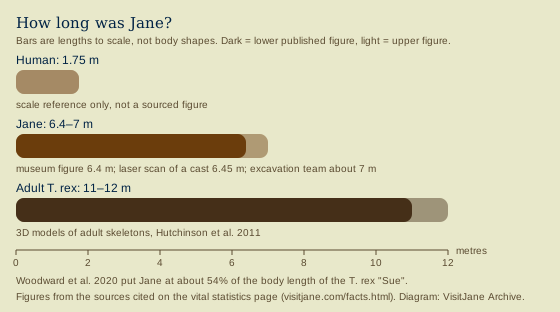
About 6.4 to 7 metres long. The length is given as about 7 metres by the excavators and 6.45 metres on a laser-scanned cast, and the weight is estimated at between 575 and 1,269 kg depending on the method.3,11,12 Four large adult T. rex skeletons in the same scanning study are 11 to 12 metres long.11 Every figure is on the Vital Statistics page.
How fast was a juvenile T. rex?
No speed has been published for Jane, and no study read for this site gives one for a young T. rex. The "20-30 miles per hour" on the original site could not be traced to a source. What has been measured is the leg: Jane's lower leg is long for its size, which W. S. Persons and Philip Currie read as a strong adaptation for running.13 The museum's current wording has no number either: "Her fine, slender bones and long legs suggest she was a fast runner".10
What did Jane eat?
Meat. Bite marks on the tail bone of a duck-billed dinosaur in the Burpee collection match the size and spacing of the teeth of a tyrannosaur at Jane's stage, so animals like Jane fed on large plant-eaters at least some of the time.14 At an average estimate of 954 kg Jane ranks as a mid-sized predator, not a giant one.4
How complete is Jane's skeleton?
The excavators recovered 145 bones, which they put at about 52 percent of the skeleton. The museum says 50 to 60 percent.3,10 The original site's "145 of her 297 bones" could not be confirmed as to the 297. See the skeleton page.
Are the bones on display real?
Yes, with restoration. The firm that built the mount in 2005 describes it as the original fossil with missing bone reconstructed.5 The skull on show is a reconstruction: the museum holds 23 original skull bones, and the artist who completed the skull says about 40 percent of it had to be sculpted.15,16
Was Jane injured?
Twice that the bones show. Four partly healed wounds on the left side of the snout match the teeth of another young tyrannosaur of about Jane's size, and a toe bone in the left foot had an infection that was active when the animal died.17 More is on the skeleton page.
How did Jane die?
That is not known. The study of the burial site gives no cause of death. It concludes only that the body was covered quickly by a flow of mud beside a river.3
Jane and T. rex


Whether any certain juvenile T. rex fossils exist, how big a young T. rex would be and how many T. rex skeletons have been found are answered on the rare discovery page.
How has Jane changed the way we think about T. rex?
The original page expected Jane to show how T. rex grew up, and studies up to 2020 used it that way.18,4 The 2025 study challenges that. Its authors write: "Our results prompt a re-evaluation of dozens of existing hypotheses based on currently indefensible ontogenetic trajectories."1 The Burpee Museum's page draws the consequence that "growth studies for T. rex will need to be re-evaluated, removing Nanotyrannus specimens from the analysis."10 If Carr is right, Jane itself remains a young T. rex and keeps its place in those studies.
The discovery


How was Jane discovered?
In 2001 a Burpee Museum expedition was surveying for fossils in Montana with the permission of the Bureau of Land Management.3 By the museum's account, on the last day two team members, Carol Tuck and Bill Harrison, "discovered pieces of bone sticking out of a bluff".19 By the museum's 2002 account each had spotted a toe bone; the original version of this page had Harrison finding a toe bone and Tuck a leg bone.20 The permit allowed only surface exploration, so the site was covered and its position recorded, and a crew came back in May 2002 with a permit to excavate.19 The original page's figures for that first trip, a team of 14 and three weeks in the field, could not be confirmed. The story continues on the discovery and excavation pages.
Where was Jane found?
In the Hell Creek Formation in northwestern Carter County, in southeastern Montana. The museum describes the find as made near the town of Ekalaka.3,21 The excavators have not published the exact location.3 The original page's population figure for Ekalaka and its driving time to the site could not be verified and are not repeated.
What is the Hell Creek Formation?
A body of sandstone and mudstone from the very end of the Cretaceous, exposed across central and eastern Montana and the western Dakotas. Most of it was laid down by rivers on a broad floodplain.22 Its top is dated to 66.052 million years ago by Sprain and colleagues.23 Its base is not settled: published estimates run from about 66.7 to about 68.4 million years, and the newest, from 2026, is about 67.1 million years or older for one study area in central Montana.22 The original page's 67 million years falls inside that range. It also listed Wyoming among the outcrops; the 2026 study names Montana and the Dakotas and gives the Lance Formation as the equivalent unit in Wyoming, and the Wyoming outcrop could not be confirmed either way.22 See Jane's world.
What is the Cretaceous Period?
The last of the three periods of the Mesozoic Era. The United States National Park Service dates it from 145.0 to 66.0 million years ago; the original page said 144 to 65.24 It ended with a mass extinction that the Park Service attributes to an asteroid striking near the Yucatan Peninsula of Mexico.24 More on the Cretaceous page.
Who owns the land where Jane was discovered?
It is federal public land managed by the Bureau of Land Management, which granted the permits for the survey and the excavation.25,3,4 The original page's remarks on how the land is used could not be checked.
Were any other fossils found with Jane?
Yes. The quarry yielded 51 genera of pollen and spores, loose bones of fish, turtles, crocodilians, lizards and other dinosaurs, and the neck vertebra of a large pterosaur, which has since been named Infernodrakon hastacollis.3,26,27 The original page gave that pterosaur a wingspan of about 20 feet, which could not be confirmed. See what was found with Jane.
Has the Burpee Museum found other fossils at Hell Creek?
Yes. In July 2005 a volunteer found "Homer", a juvenile Triceratops, at a site that proved to hold three young animals of similar size.28,29 The museum also has a second small tyrannosaur from Carter County, BMRP 2006.4.4, and remains of a giant oviraptorosaur it calls "Pearl".4,30 It still runs yearly expeditions from Ekalaka.31
The museum


Where is Jane now?
At the Burpee Museum of Natural History, 737 North Main Street, Rockford, Illinois, where the museum's website lists the Jane exhibit among those on the first floor.32,33 The exhibit opened on 29 June 2005.34 For opening hours and admission, use the museum's own visitor page. Casts of the skeleton are shown elsewhere; see casts and Where Jane lives.
What is the Burpee Museum of Natural History?
A natural history museum in Rockford. Its own pages give two starting dates: one says the first museum opened, free to the public, in 1941, and another that it opened its doors in the Barnes Mansion in 1942.35,9 It stands next to Riverfront Museum Park, which houses the Discovery Center Museum and the Rockford Art Museum and is linked to the Burpee by a tunnel.36 The floor area and other figures on the original page could not be verified. See the Burpee Museum page.
Where is Rockford?
In Illinois. A 2005 Associated Press report placed it about 100 miles northwest of Chicago, a journalist's round figure.37 The population, ranking and driving time on the original page could not be checked against a primary source and are left out. See the Rockford page.
Who paid for the Jane project?
Sponsors paid for the expedition; state, federal and private money paid for the exhibit, according to a 2005 Associated Press report. The museum's 2002 page of expedition sponsors lists eleven, among them the AMCORE Foundation, Estwing Manufacturing Company, LaSalle Bank, the Rockford Park District, the Rockford Area Convention and Visitors Bureau and the Woods Equipment Company.38 The Associated Press reported in 2005 that the museum's president raised $100,000 from residents and businesses in five days, and that the exhibit received about $1 million in state funds and $350,000 in federal and private money.37 Several names on the original page's list do not appear in the sources read and are not repeated.
Is this the museum's website?
No. This site is an independent archive about Jane and is not affiliated with the Burpee Museum of Natural History. For tickets, events and anything else about visiting, go to the museum's visitor page. More about this archive is on the about page.
Related pages: Vital Statistics · Is Jane a Nanotyrannus? · The skeleton · Jane's world · A rare discovery
Sources
- Zanno, L. E. & Napoli, J. G. (2025). Nanotyrannus and Tyrannosaurus coexisted at the close of the Cretaceous. Nature 648: 357–367, published 30 October 2025, with Supplementary Information. doi:10.1038/s41586-025-09801-6. The main text is behind a paywall; this page relies on the abstract, figure captions, data statement and the Supplementary Information.
- Simms, C. (2025). "Nanotyrannus isn't a 'mini T. Rex' after all — it's a new species, 'dueling dinosaurs' fossil reveals." Live Science, 30 October 2025. livescience.com
- Henderson, M. D. & Harrison, W. H. (2008). Taphonomy and environment of deposition of a juvenile tyrannosaurid skeleton from the Hell Creek Formation (latest Maastrichtian) of southeastern Montana. In Larson & Carpenter (eds), Tyrannosaurus rex, the Tyrant King, Indiana University Press, pp. 82–90. Read in the text deposited at zenodo.org/records/4572551.
- Woodward, H. N., Tremaine, K., Williams, S. A., Zanno, L. E., Horner, J. R. & Myhrvold, N. P. (2020). Growing up Tyrannosaurus rex: Osteohistology refutes the pygmy "Nanotyrannus" and supports ontogenetic niche partitioning in juvenile Tyrannosaurus. Science Advances 6(1): eaax6250. doi:10.1126/sciadv.aax6250
- Research Casting International. "Jane the Tyrannosaurus Rex" (case study, project dated 2005). rescast.com
- Woodward, H. N., Myhrvold, N. P. & Horner, J. R. (2026). Prolonged growth and extended subadult development in the Tyrannosaurus rex species complex revealed by expanded histological sampling and statistical modeling. PeerJ 14: e20469. doi:10.7717/peerj.20469
- Burpee Museum of Natural History (2015). "Jane: Do the tails tell the tale?" No Stone Unturned (museum blog), 15 April 2015. blogburpee.wordpress.com
- Field Museum. "SUE the T. rex" (web page). fieldmuseum.org. Accessed 5 October 2026.
- Burpee Museum of Natural History. "Our Mission" (web page, includes "Our Story"). burpee.org/our-mission. Accessed 5 October 2026.
- Burpee Museum of Natural History. "Jane" (web page headed "Jane: NOT a juvenile Tyrannosaur??"). burpee.org/jane. Accessed 5 October 2026.
- Hutchinson, J. R., Bates, K. T., Molnar, J., Allen, V. & Makovicky, P. J. (2011). A computational analysis of limb and body dimensions in Tyrannosaurus rex with implications for locomotion, ontogeny, and growth. PLoS ONE 6(10): e26037. doi:10.1371/journal.pone.0026037
- Snively, E., O'Brien, H., Henderson, D. M., Mallison, H., Surring, L. A. et al. (2019). Lower rotational inertia and larger leg muscles indicate more rapid turns in tyrannosaurids than in other large theropods. PeerJ 7: e6432. doi:10.7717/peerj.6432
- Persons, W. S. & Currie, P. J. (2016). An approach to scoring cursorial limb proportions in carnivorous dinosaurs and an attempt to account for allometry. Scientific Reports 6: 19828. doi:10.1038/srep19828
- Peterson, J. E. & Daus, K. N. (2019). Feeding traces attributable to juvenile Tyrannosaurus rex offer insight into ontogenetic dietary trends. PeerJ 7: e6573. doi:10.7717/peerj.6573
- Burpee Museum of Natural History (2005). "Jane's Skeleton" (web page, archived 3 April 2005). web.archive.org
- Keillor, T. "'Jane' juvenile tyrannosaur skull" and "'Jane' juvenile tyrannosaur" (artist's website, undated). tylerkeillor.com
- Peterson, J. E., Henderson, M. D., Scherer, R. P. & Vittore, C. P. (2009). Face biting on a juvenile tyrannosaurid and behavioral implications. PALAIOS 24(11): 780–784. doi:10.2110/palo.2009.p09-056r
- Carr, T. D. (2020). A high-resolution growth series of Tyrannosaurus rex obtained from multiple lines of evidence. PeerJ 8: e9192. doi:10.7717/peerj.9192
- Burpee Museum of Natural History (2005). "Jane's Discovery" (web page, archived 3 April 2005). web.archive.org
- Burpee Museum of Natural History (2002). "Jane's Team" (web page, archived 8 November 2002). web.archive.org
- Burpee Museum of Natural History. "Highway To Hell Creek" (web page). burpee.org/highway-to-hell-creek. Accessed 5 October 2026.
- Roberts, E. M., Hendrix, M. S., Ramezani, J., Clyde, W. C., Zippi, P., Hodgson, S., Yuleridge, V. & Zanno, L. E. (2026). A high precision CA-ID-TIMS U-Pb zircon age for the "Dueling Dinosaurs" locality, with implications for regional correlation, basal age and duration of the Hell Creek Formation, Montana. PLOS One 21(5): e0328861. doi:10.1371/journal.pone.0328861
- Sprain, C. J., Renne, P. R., Clemens, W. A. & Wilson, G. P. (2018). Calibration of chron C29r: New high-precision geochronologic and paleomagnetic constraints from the Hell Creek region, Montana. Geological Society of America Bulletin 130. doi:10.1130/b31890.1 (abstract read)
- U.S. National Park Service. "Cretaceous Period—145.0 to 66.0 MYA" (web page). nps.gov. Accessed 5 October 2026.
- Bureau of Land Management (2020). "It's settled! Jane was a juvenile, not another species." Blog post, 20 March 2020. blm.gov
- Thomas, H., Hone, D. W. E., Gomes, T. & Peterson, J. E. (2024). Infernodrakon hastacollis gen. et sp. nov., a new azhdarchid pterosaur from the Hell Creek Formation of Montana, and the pterosaur diversity of Maastrichtian North America. Journal of Vertebrate Paleontology. doi:10.1080/02724634.2024.2442476 (abstract read)
- Hone, D. (2025). "Welcome Infernodrakon – a new azhdarchid." Dave Hone's Archosaur Musings (blog of a co-author of the description), 4 March 2025. archosaurmusings.wordpress.com
- Burpee Museum of Natural History (2006). "The Triceratops are coming to Rockford!" Press release, August 2006 (PDF, archived 1 July 2007). web.archive.org
- Burpee Museum of Natural History (2013). "Big news at Burpee." No Stone Unturned (museum blog), 5 February 2013. blogburpee.wordpress.com
- "Meet 'Pearl': The Next Big Thing At Burpee." Northern Public Radio (WNIJ), 1 December 2014. northernpublicradio.org
- Burpee Museum of Natural History. "Expeditions FAQ" (web page). burpee.org/expeditions-faq. Accessed 5 October 2026.
- Burpee Museum of Natural History. "Visit Burpee" (web page). burpee.org/visit-burpee. Accessed 5 October 2026.
- Burpee Museum of Natural History. "First Floor Exhibits" (web page). burpee.org/first-floor. Accessed 5 October 2026.
- Advanced Computing Center for the Arts and Design, The Ohio State University. "Jane: Diary of a Dinosaur" (project page). accad.osu.edu. Accessed 5 October 2026.
- Burpee Museum of Natural History. "Our Museum History" (web page). burpee.org/burpee-museum-history. Accessed 5 October 2026.
- Illinois Office of Tourism. "Riverfront Museum Park" (Enjoy Illinois listing). enjoyillinois.com. Accessed 5 October 2026.
- Associated Press (2005). "Junior fossil find puts small museum on map." Lawrence Journal-World, 26 July 2005. ljworld.com
- Burpee Museum of Natural History (2002). "Sponsors of the Montana Expedition" (web page, archived 1 October 2002). web.archive.org