


Nanotyrannus vs T. rex
Last updated 7 October 2026 · 21 sources
As described in 2025, the best-known Nanotyrannus skeleton is about half the length and a tenth of the mass of a full-grown Tyrannosaurus rex, and the genus is set apart by more teeth, a larger hand for its size and fewer tail vertebrae.1,9 As late as 2020 most specialists read the same fossils as young T. rex, and for Jane, the Burpee Museum's skeleton, the question is still open: Thomas Carr reads it as a juvenile T. rex.3,9
This page sets the two animals side by side, one feature at a time. Each number is tied to the fossil it was taken from, because the comparison rests on very few specimens. For how the argument unfolded and who accepts what, see Is Jane a Nanotyrannus?
The fossils behind the numbers


| Fossil | What it is | Growth stage |
|---|---|---|
| The Cleveland skull, CMNH 7541 | The original Nanotyrannus lancensis: a skull with lower jaws, 572 mm long, and no other bones3 | At or near skeletal maturity, from the microscopic structure of a throat bone8 |
| The Dueling Dinosaurs tyrannosaur, NCSM 40000 | A well-preserved skeleton assigned to N. lancensis, and the basis of the 2025 description of the genus1 | Mature or nearly so: around 20 years old and "physically mature" in the university's summary of the study, "near somatically mature" in the paper's abstract2,1 |
| Jane, BMRP 2002.4.1 | A skull and much of the body. Type specimen of N. lethaeus since 2025; a juvenile T. rex in the other reading1,9 | Immature and still growing; at least 13 years old by the 2020 count3 |
| Adult T. rex | In the tables below, mainly the four large skeletons modelled in a 2011 study (the Carnegie specimen CM 9380, Sue, Stan and MOR 555) and the adults in Thomas Carr's 2020 growth series6,4 | Adult |
The size, arm, tail and growth-layer statements below are reported for NCSM 40000 or for the genus as a whole; Jane's own measurements are listed separately wherever they exist.
Tooth counts

.jpg)
| Animal | Teeth in each upper jaw bone (maxilla) | Teeth in each lower jaw (dentary) | Counted by |
|---|---|---|---|
| NCSM 40000 | 16 and 17 | Not given separately in the material read; 16 to 18 across Nanotyrannus | Zanno and Napoli1 |
| Jane | 16 | Not stated for Jane in any study read for this site | Zanno and Napoli1 |
| Carr's growth stage 5, the stage his series assigns to Jane (Jane is counted as T. rex there; the stage may rest largely on Jane itself). Not a second animal | 16 | 17 | Carr4 |
| Adult T. rex | 11 to 12 | 12 to 14 | Carr4 |
| T. rex, all individuals accepted as such by Zanno and Napoli | 11 to 12 | 12 to 13 | Zanno and Napoli1 |
The two camps report similar counts. They disagree about whether a tyrannosaur can lose tooth positions as it grows. Carr's series has the count first rising and then falling with age, from 16 to 11 in the upper jaw and from 17 to 12 in the lower.4 He notes that the upper-jaw trend is not statistically significant and that upper-jaw counts for subadult specimens, the stage in between, are not known.4 Carr's paper, as read for this site, does not state Jane's tooth count in a sentence of its own; the figures are those of the growth stage his series places Jane in. Nicholas Longrich and Evan Saitta reply that within T. rex tooth count shows no clear relation to the length of the tooth row, so the difference does not come from size or age.5
In one detail of the lower jaw Jane matches T. rex and not NCSM 40000. In NCSM 40000 the first two tooth sockets are distinctly smaller than the rest. In T. rex and in Jane only the first is. Zanno and Napoli use this to separate Jane's species from N. lancensis, and argue that the feature is set before hatching.1
Tooth shape

_4_(15320935656).jpg)
| Feature | Jane and Nanotyrannus | Adult T. rex |
|---|---|---|
| Width of a tooth as a share of its length, averaged over all teeth | 54% in Jane (34 teeth measured) | 71% to 85% in four adults; 68% in a young adult, MOR 11254 |
| Cross-section | Flattened from side to side, with sharp crowns | Robust, blunt crowns, as in the adult Stan20 |
| Front teeth of the upper jaw (premaxillary teeth) | Blunt-tipped crowns without serrations in the genus diagnosis. In Jane, Longrich reports from his own observation a few weak serrations near the base1,13 | Not described in the material read |
The 2009 study of Jane's face wounds calls side-to-side flattening of the teeth a characteristic of juvenile tyrannosaurids in general.18 Longrich and Saitta list the same flattening as a feature of Nanotyrannus.5
Arms and hands

.jpg)
| Measure | Nanotyrannus and Jane | T. rex | Fossil and source |
|---|---|---|---|
| Arm bones against the thigh bone | Larger upper arm bone and hand relative to the length of the femur | Smaller | Genus diagnosis, Zanno and Napoli1 |
| Absolute size, as worded in the genus diagnosis | "absolutely larger forelimb elements" | Smaller | Supplementary Information, Zanno and Napoli1 |
| Absolute size, as worded in a figure caption | Upper arm bone "absolutely shorter", hand "absolutely longer" | Upper arm bone longer, hand shorter | NCSM 40000, Fig. 5 caption of the same paper1 |
| Arm as a share of body mass | 2.8% in Jane (modelled as a juvenile T. rex in that study) | 0.1% to 0.4% in four adults | Computer models built on laser scans; Jane's scan was of a cast6 |
The two statements about absolute size come from the same paper and do not obviously agree about the upper arm bone. The material read for this site does not reconcile them; the main text, which may explain the difference, is behind a paywall and was not read.
No study read for this site gives a measured length for Jane's upper arm bone or hand. Jane's upper arm bone is heavily crushed and Jane was immature, and Zanno and Napoli left differences in the upper arm bone out of their definitions of the two species.1
The 2011 modelling study read Jane's proportionally large arm as a change with age inside T. rex.6 Gregory Paul argued in June 2025, in a paper read here only as an abstract, that a number of small tyrannosaurs cannot be juvenile Tyrannosaurus because their hands are as large as or larger than those of big adults, and limbs do not shrink with maturity. The abstract does not name Jane.17 The university's summary of the 2025 study lists larger forelimbs among features fixed early in development.2
Legs
For NCSM 40000 the material read gives only the shin bone, and for adult T. rex it gives no shin or foot bone lengths, so most of this table sets Jane against adult T. rex. A dash marks a figure that is not in the material read.
| Bone or measure | NCSM 40000 | Jane | Adult T. rex |
|---|---|---|---|
| Thigh bone (femur) | — | 688 mm estimated from the incomplete bone (68.8 cm in the source); 720 mm in a second study; 788 mm on a scan of the mounted cast (0.788 m) | About 1,300 mm (1.3 m) in four adults3,7,6 |
| Shin bone (tibia) | 782 mm | 854 mm (Zanno and Napoli); 836 mm (Persons and Currie) | —1,7 |
| Long foot bone (metatarsal III) | — | 563 mm | —7 |
| Whole leg | — | 2,125 mm on the cast scan (2.125 m) | 3,000 to 3,300 mm (3 to 3.3 m)6 |
In Jane the shin and long foot bone together measure 1,399 mm, almost twice the 720 mm thigh bone in the same table.7 Persons and Currie scored how much longer the lower leg is than expected for a meat-eating dinosaur of that size. Jane's score of 35.8 and that of a second small specimen exceeded every other tyrannosaur they measured, including young Albertosaurus and Gorgosaurus of similar size.7 They took this as support for Nanotyrannus, and added a caution in 2016: "there is, as yet, no clearly identified juvenile T. rex specimen with limb proportions different from the referred N. lancensis specimens."7
Two studies that included Jane as a juvenile T. rex did not address its identity. A 2020 study of locomotion noted that tyrannosaurs younger than 10 to 15 years would still be at a size where long legs could be used for top speed.19 A 2019 study of turning ability, which used Jane as its juvenile T. rex, found that juveniles and adults fell on one continuous trend for that measure.16 Both studies assumed that Jane was a T. rex; neither set out to test Jane's identity.
Two smaller points concern Jane alone. Longrich and colleagues report that Jane lacks a strong downward bend at the far end of the long foot bone, which the authors contrast with T. rex.13 In the hip, the shaft of the pubic bone is straight in N. lancensis and most tyrannosaurids, and curved in Jane, Albertosaurus and Tyrannosaurus, so on this one character Jane resembles T. rex more than it resembles the other Nanotyrannus species.1
Skull

.jpg)


| Feature | Nanotyrannus and Jane | T. rex |
|---|---|---|
| Skull length | Cleveland skull 572 mm. Jane about 710 mm, 720 mm or 74 cm, depending on the study; all three are estimates for a skull found in pieces | Carr's juvenile category ends at 80 cm; no adult length is given in the material read3,4,5 |
| Overall shape | Jane falls in Carr's large-juvenile category, defined by long, low skulls at least 3.0 times as long as high | In Carr's series the change from a shallow to a deep skull falls between 13 and 15 years of age4 |
| Opening below the nostril, visible from outside (subnarial foramen) | Absent in NCSM 40000, the Cleveland skull and Jane | Zanno and Napoli write that its absence is unknown in other tyrannosaurs1 |
| Horn-like projection on the lacrimal, the bone in front of the eye | Present in the genus diagnosis | Listed as a difference from Tyrannosaurus1 |
| Horn-like projection on the postorbital, the bone behind the eye | Absent in the genus diagnosis | Listed as a difference from Tyrannosaurus1 |
| Air-filled hollow in the quadratojugal, a bone at the rear of the cheek | Present in the genus diagnosis | Listed as a difference from Tyrannosaurus1 |
| Groove along the outside of the lower jaw | Distinct in Jane and the Cleveland skull | Said to be lacking in a 2016 paper; in Carr's series, reduced to short segments in adults11,4 |
| Lower part of the lacrimal | Strongly curved in the Cleveland skull and Jane | Straightens in subadults, according to Carr4 |
The groove in the lower jaw shows how one observation supports both readings. Schmerge and Rothschild examined Jane's skull at the Burpee Museum and concluded in 2016 that the groove sets Jane and similar specimens apart as a separate genus.11 Brusatte, Carr, Williamson and Holtz answered that well-defined grooves are what a juvenile T. rex should have.12
Several of Jane's face bones are rough and heavily sculptured. Longrich and Saitta take that as a sign of approaching maturity; Carr records an increase in surface relief at Jane's growth stage as part of normal T. rex growth.5,4 Longrich and Saitta illustrate differences from T. rex in nine of Jane's skull and jaw bones, and count more than 150 differing characters between Nanotyrannus and T. rex overall.5
Tail vertebrae
Zanno and Napoli give Nanotyrannus 35 tail vertebrae and list this as fewer than in Tyrannosaurus.1 The university's summary names fewer tail vertebrae among the features of the Dueling Dinosaurs skeleton that are fixed early in development.2 The parts of the paper read for this site do not state the count for T. rex.
Jane cannot be checked against this figure from the material read for this site. The excavators describe a run of 16 vertebrae from the base of the tail, found arcing over the back; a full count for Jane's tail is not in the material read.14
Body size


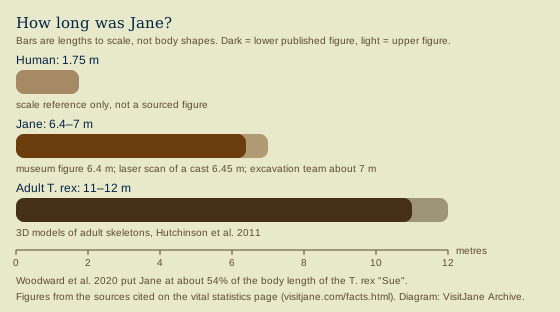
| Animal | Length | Body mass |
|---|---|---|
| NCSM 40000, mature or nearly so | Half the length of a full-grown T. rex | About a tenth of its mass, in Lindsay Zanno's words to Live Science9 |
| Jane, still growing | About 7 m according to the excavators; 6.45 m on a scan of the cast | 575 to 1,269 kg across the three studies cited, each with its own method14,6,16,5 |
| Adult T. rex, four skeletons | 11 to 12 m | 5,777 to 18,489 kg between the leanest and fullest models6 |
Jane's linear dimensions are about 50 to 65 percent of those of the four adults.6 What Jane would have grown into is the open question. Longrich and Saitta's growth curves predict an adult of roughly 1,200 to 2,100 kg.5 Zanno and Napoli write that no mature specimen of N. lethaeus exists from which to derive an adult mass, and Napoli's university says only that the species would have been slightly larger than N. lancensis as an adult.1,21 In the juvenile T. rex reading the adult is T. rex itself. Each camp's figures for Jane are on the Vital Statistics page.
Growth


| Evidence | Finding | Fossil and source |
|---|---|---|
| Outer bone layer that marks the end of growth (external fundamental system) | Present in the thigh and shin bones | NCSM 40000, as reported by Woodward and colleagues10 |
| The same layer | Absent; the animal was still growing | Jane, in the 2020 and 2026 studies by Woodward and colleagues3,10 |
| Growth marks in the thigh bone | 13 marks, read as at least 13 years (Woodward and colleagues, 2020); the same section read as eight years of preserved growth, which is not an age at death (Zanno and Napoli); 9 growth lines, or 6 after merging doubled lines (Longrich and Saitta) | Jane3,1,5 |
| Largest gain between two growth rings | About 149 kg, against a peak above 800 kg a year that the same authors calculate for T. rex from Sue | Jane, in Longrich and Saitta's table; the bone circumferences were estimated5 |
| Growth curve fitted to the whole record | Statistically incompatible with the other Tyrannosaurus in the data set | Jane and the second Burpee specimen, BMRP 2006.4.4; Woodward, Myhrvold and Horner, 202610 |
| Size reached in under 20 years | More than 6,000 kg | Adult T. rex, from the 2011 modelling study6 |
The 2011 study describes T. rex as passing 6,000 kg in under 20 years. NCSM 40000, at around 20 years, was mature or nearly so at about a tenth of the mass of a full-grown T. rex, in Zanno's words. That result concerns NCSM 40000. For Jane the bone evidence is less direct. The 2026 study found Jane's growth out of line with T. rex and declined to draw a conclusion about species from that alone; its authors list local conditions, a size difference between the sexes, atypical growth and disease as other explanations to test.10
The state of Jane's backbone is itself contested. The excavators reported in 2008 that the upper arches of the vertebrae had not fused to the bodies of the vertebrae, which they took to indicate a juvenile.14 Longrich and Saitta, citing Peter Larson, report fusion or partial fusion in the same region and in the shoulder and hip, and read Jane as a nearly full-sized subadult or early adult.5 No source read for this site reconciles the two descriptions.
Under the growth reading, T. rex changed abruptly between the juvenile and subadult stages; Carr calls it a secondary metamorphosis.4
Place in the family tree
| Who | Where Nanotyrannus belongs |
|---|---|
| Zanno and Napoli, 2025 | Outside Tyrannosauridae, the family that contains T. rex, with two species: N. lancensis and N. lethaeus1 |
| Longrich and Saitta, 2024 | A distinct animal that lacks the characters needed to place it in Tyrannosaurus and may lie outside Tyrannosauridae5 |
| Thomas Carr, October 2025 | As paraphrased by Live Science: the Dueling Dinosaurs animal is a sister species of T. rex and should be named Tyrannosaurus lancensis. Jane, in his view, is a juvenile T. rex9 |
| Woodward and colleagues, 2020 | Not a separate animal: their results supported merging Nanotyrannus into Tyrannosaurus. The paper left open that Nanotyrannus might be valid but known only from immature animals. In 2026 Woodward and two of the same co-authors accepted a different species as one possible explanation for Jane's growth3,10 |
Later proposals about which genus Jane's species belongs in are covered on the Nanotyrannus page.
One feature, two readings
| Feature | Read as a species difference | Read as a growth stage |
|---|---|---|
| More teeth | Tooth count does not change with jaw size inside T. rex (Longrich and Saitta)5 | T. rex lost tooth positions as it grew (Carr)4 |
| Narrow, blade-like teeth | A feature of Nanotyrannus (Longrich and Saitta)5 | Typical of juvenile tyrannosaurids in general (Peterson and colleagues)18 |
| Large arms and hands | Limbs do not shrink with age (Paul); fixed early in development (Zanno and Napoli's university summary)17,2 | A change with age (Hutchinson and colleagues)6 |
| Long lower legs | Beyond any other tyrannosaur measured, young ones included (Persons and Currie)7 | Young tyrannosaurs were at a size where long legs served top speed (Dececchi and colleagues, who treated Jane as T. rex)19 |
| Groove in the lower jaw | Marks a separate genus (Schmerge and Rothschild)11 | Expected in a juvenile; fades with age (Brusatte and colleagues; Carr)12,4 |
| Rough, sculptured face bones in Jane | A sign of approaching maturity at small size (Longrich and Saitta)5 | Part of normal T. rex growth at that stage (Carr)4 |
| Small body | NCSM 40000 and the Cleveland skull were mature or nearly so at that size (Zanno and Napoli; Griffin and colleagues)2,8 | Jane was immature, as a young T. rex would be (Woodward and colleagues, 2020)3 |
Former opponents of Nanotyrannus, among them Carr, Brusatte and Holtz, have accepted on record that NCSM 40000 is a small adult.9,15 Jane is the harder case. Steve Brusatte's reason, given to Live Science, is that the skeleton had not stopped growing, which makes it very hard to tell a Nanotyrannus from a juvenile T. rex.9 Holly Woodward Ballard's objection, as reported by Science News, is that Jane was already bigger than N. lancensis while still a juvenile.15
Common questions
Is Nanotyrannus a T. rex?
According to two studies published in late 2025, no: the Dueling Dinosaurs skeleton and the Cleveland skull were mature or nearly so, and far smaller than an adult T. rex.1,8 Thomas Carr accepts that the Dueling Dinosaurs animal is a small adult but, as paraphrased by Live Science, would place it in the genus Tyrannosaurus as a separate species.9
Is Jane a Nanotyrannus?
Zanno and Napoli made Jane the type specimen of Nanotyrannus lethaeus in 2025; Thomas Carr reads Jane as a juvenile T. rex.1,9 The full account is on the Nanotyrannus page.
Related pages: Is Jane a Nanotyrannus? · Vital Statistics · How rare is Jane? · The skeleton
Sources
- Zanno, L. E. & Napoli, J. G. (2025). Nanotyrannus and Tyrannosaurus coexisted at the close of the Cretaceous. Nature 648: 357–367, published 30 October 2025, with Supplementary Information. doi:10.1038/s41586-025-09801-6. The main text is behind a paywall; this page relies on the abstract, figure captions and the Supplementary Information.
- Peake, T. (2025). "Nanotyrannus Confirmed: Dueling Dinosaurs Fossil Rewrites the Story of T. rex." NC State University News, 30 October 2025. news.ncsu.edu
- Woodward, H. N., Tremaine, K., Williams, S. A., Zanno, L. E., Horner, J. R. & Myhrvold, N. P. (2020). Growing up Tyrannosaurus rex: Osteohistology refutes the pygmy "Nanotyrannus" and supports ontogenetic niche partitioning in juvenile Tyrannosaurus. Science Advances 6(1): eaax6250. doi:10.1126/sciadv.aax6250
- Carr, T. D. (2020). A high-resolution growth series of Tyrannosaurus rex obtained from multiple lines of evidence. PeerJ 8: e9192. doi:10.7717/peerj.9192
- Longrich, N. R. & Saitta, E. T. (2024). Taxonomic status of Nanotyrannus lancensis (Dinosauria: Tyrannosauroidea), a distinct taxon of small-bodied tyrannosaur. Fossil Studies 2(1): 1–65. doi:10.3390/fossils2010001
- Hutchinson, J. R., Bates, K. T., Molnar, J., Allen, V. & Makovicky, P. J. (2011). A computational analysis of limb and body dimensions in Tyrannosaurus rex with implications for locomotion, ontogeny, and growth. PLoS ONE 6(10): e26037. doi:10.1371/journal.pone.0026037
- Persons, W. S. & Currie, P. J. (2016). An approach to scoring cursorial limb proportions in carnivorous dinosaurs and an attempt to account for allometry. Scientific Reports 6: 19828. doi:10.1038/srep19828
- Griffin, C. T., Bugos, J., Poust, A. W., Morris, Z. S., Sombathy, R. S., D'Emic, M. D., O'Connor, P. M., Petermann, H., Fabbri, M. & Colleary, C. (2026). A diminutive tyrannosaur lived alongside Tyrannosaurus rex. Science 391(6782): 300–305, first published online 4 December 2025. doi:10.1126/science.adx8706. Abstract only.
- Simms, C. (2025). "Nanotyrannus isn't a 'mini T. Rex' after all — it's a new species, 'dueling dinosaurs' fossil reveals." Live Science, 30 October 2025. livescience.com
- Woodward, H. N., Myhrvold, N. P. & Horner, J. R. (2026). Prolonged growth and extended subadult development in the Tyrannosaurus rex species complex revealed by expanded histological sampling and statistical modeling. PeerJ 14: e20469. doi:10.7717/peerj.20469
- Schmerge, J. D. & Rothschild, B. M. (2016). Distribution of the dentary groove of theropod dinosaurs: Implications for theropod phylogeny and the validity of the genus Nanotyrannus Bakker et al., 1988. Cretaceous Research 61: 26–33. doi:10.1016/j.cretres.2015.12.016
- Brusatte, S. L., Carr, T. D., Williamson, T. E. & Holtz, T. R. Jr (2016). Dentary groove morphology does not distinguish 'Nanotyrannus' as a valid taxon of tyrannosauroid dinosaur. Cretaceous Research 65: 232–237. doi:10.1016/j.cretres.2016.02.007
- Longrich, N. R., Makovicky, P. J., Tokaryk, T., Cooper, D. M. L., Saitta, E. T., Erickson, G. M., Szekely, T. & Snively, E. (2026). Hatchlings of Tyrannosaurus rex and the evolution of dinosaur reproductive strategies. Biology 15(13): 1090. doi:10.3390/biology15131090
- Henderson, M. D. & Harrison, W. H. (2008). Taphonomy and environment of deposition of a juvenile tyrannosaurid skeleton from the Hell Creek Formation (latest Maastrichtian) of southeastern Montana. In Larson & Carpenter (eds), Tyrannosaurus rex, the Tyrant King, Indiana University Press, pp. 82–90.
- Gramling, C. (2025). "Nanotyrannus was not a teenaged T. rex." Science News, 30 October 2025. sciencenews.org
- Snively, E., O'Brien, H., Henderson, D. M., Mallison, H., Surring, L. A. et al. (2019). Lower rotational inertia and larger leg muscles indicate more rapid turns in tyrannosaurids than in other large theropods. PeerJ 7: e6432. doi:10.7717/peerj.6432
- Paul, G. S. (2025). A presentation of the current data on the exceptionally diverse non-tyrannosaurid eutyrannosaur and tyrannosaurini genera and species of western North America… Mesozoic 2(2): 085–138. doi:10.11646/mesozoic.2.2.1. Abstract only.
- Peterson, J. E., Henderson, M. D., Scherer, R. P. & Vittore, C. P. (2009). Face biting on a juvenile tyrannosaurid and behavioral implications. PALAIOS 24(11): 780–784. doi:10.2110/palo.2009.p09-056r
- Dececchi, T. A., Mloszewska, A. M., Holtz, T. R. Jr, Habib, M. B. & Larsson, H. C. E. (2020). The fast and the frugal: Divergent locomotory strategies drive limb lengthening in theropod dinosaurs. PLoS ONE 15(5): e0223698. doi:10.1371/journal.pone.0223698
- Peterson, J. E. & Daus, K. N. (2019). Feeding traces attributable to juvenile Tyrannosaurus rex offer insight into ontogenetic dietary trends. PeerJ 7: e6573. doi:10.7717/peerj.6573
- Stony Brook University News (2025). "Rewriting the Story of the Tyrannosaurus Rex." 4 November 2025. news.stonybrook.edu